Article
Solar Boombox vs. Bluetooth Speaker: Which Outdoor Audio Should You Buy?
Quick Answer
Solar Boombox vs. Bluetooth Speaker: Which Outdoor Audio Should You Buy?: quick answer
The simplest difference is movement.
- Topic: Outdoor Audio.
- Related product category: bluetooth-speakers.
- This article keeps the main answer in the article copy and places relevant product context inside the guide.
Quick Answer: Choose by How Your Music Moves
The simplest difference is movement.
Buy a portable Bluetooth speaker if the speaker moves with you. Hiking, biking, paddleboarding, day trips, hotel rooms, backpacks, and small picnic tables all favor a compact speaker. It is easier to carry, easier to clip, easier to pack, and often more durable for active use.
Buy a solar boombox if the speaker mostly stays in one place outdoors. Campsites, tailgates, pool areas, beach blankets, picnic shelters, job-site corners, patios, and backyard tables are better matches. The solar panel is not magic and it is not an instant charger. Its real job is to extend battery life when the speaker sits in usable daylight.
That distinction prevents the most common buying mistake. A solar boombox is not automatically better because it has solar. A portable Bluetooth speaker is not automatically better because it is smaller. They solve different outdoor audio problems.
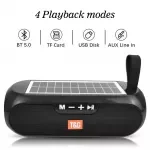
The Solar Boombox (#p-021423, $36.95) belongs on the solar side of the decision: budget-friendly, outdoor-oriented, larger than pocket speakers, and useful when charging discipline is weak. The honest limit is important: at this price, the solar panel should be treated as a top-up feature, not as a guarantee that music will run forever.
Use this shortcut:
- If you carry it all day: buy a portable Bluetooth speaker.
- If you set it down in daylight: consider a solar boombox.
- If you need premium sound: compare specific models, not categories.
- If you camp for multiple days: solar top-up becomes more useful.
- If you mostly listen indoors: solar probably does not matter.
The Core Difference: Battery Source vs. Battery Habit
Both products are battery-powered speakers. The solar boombox simply adds a second charging path.
A normal Bluetooth speaker is a closed battery system during the trip. You charge it before leaving. It plays until the battery drops. Then it needs a wall outlet, car charger, or power bank. That system is fine if you remember to charge devices and your trips are short.
A solar boombox still needs a battery. The solar panel does not replace the internal battery; it supports it. In useful sunlight, the panel can add charge over time or slow the drain while the speaker is sitting outside. In shade, clouds, rain, dusk, night, or indoor use, the advantage drops sharply.
This matters because solar performance is often misunderstood. Solar panels need light, and their output changes with angle, weather, shade, temperature, panel size, and product design. Larger home solar panels can still produce some power on cloudy days, but output is much lower than in direct sun. A small speaker-mounted panel has even less surface area, so expectations should be modest.
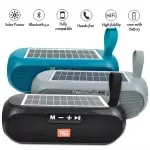
The practical way to think about a solar boombox is this:
It is a battery speaker with a daylight top-up feature.
That top-up can be valuable. A beach day, a campsite lunch table, a sunny tailgate, or a patio afternoon gives the panel time to work. But it is not a substitute for charging before the trip. The best habit is still to charge it fully at home, then let the solar panel help during the day.
Round 1: Battery Life
Battery life is the main reason people consider solar outdoor audio.
Portable Bluetooth speakers vary widely. Small clip-on speakers may last a workday or afternoon. Larger portable speakers can advertise longer battery life, but real playtime depends on volume, bass-heavy music, LED lights, Bluetooth version, battery age, temperature, and whether the speaker is also charging another device. Review sites often warn buyers to treat battery claims as best-case estimates rather than guarantees.
Solar boomboxes add a useful twist: sunlight can help extend the session. If the speaker sits in clear daylight for several hours, it may recover some charge or reduce how fast the battery drains. That is especially helpful for people who forget to charge gear before trips.
But solar charging is slow compared with plugging into a wall. A small panel on a speaker cannot refill a large battery quickly the way a wall charger can. It also cannot do meaningful work at night. If the speaker spends the whole day under a canopy, inside a tent, under a beach umbrella, or in a shaded trunk, the solar feature barely helps.
Winner: solar boombox for sunny, stationary, multi-hour use.
Bluetooth still wins when: you start fully charged, only need a few hours, and want lighter gear.
Buying lesson: do not compare advertised battery hours alone. Ask where the speaker will sit, how loud you play music, and whether sun exposure is realistic.
Round 2: Sound and Volume
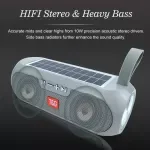
Bigger speakers usually have a physical advantage. More cabinet volume, larger drivers, and more room for passive radiators can create fuller sound and stronger bass than a tiny pocket speaker. This is why boombox-style speakers often feel more satisfying at a campsite, tailgate, or backyard gathering.
But category does not guarantee quality.
A well-designed compact Bluetooth speaker from a strong audio brand can sound cleaner than a cheap large boombox. A budget boombox may play louder but distort at high volume. A small speaker may have better tuning, a companion app, EQ control, or better vocal clarity. The enclosure shape, driver quality, amplifier, tuning, and DSP all matter.
Outdoor audio also changes how sound is perceived. Indoors, walls reflect sound and make speakers feel fuller. Outdoors, sound disperses. Bass feels weaker. Wind, conversation, waves, traffic, and campsite noise compete with the speaker. A speaker that sounds loud in a bedroom may feel small outside.
For a picnic table, a compact Bluetooth speaker is usually enough. For a yard, campsite group, tailgate, or beach blanket, a larger boombox can make more sense.
Winner: solar boombox for casual volume and outdoor presence.
Bluetooth still wins when: sound quality from a specific premium portable model matters more than size or solar.
Buying lesson: listen for distortion at the volume you will actually use. A speaker that only sounds good at low volume may disappoint outdoors.
Round 3: Portability
This is where the Bluetooth speaker wins cleanly.
Portable Bluetooth speakers are designed to travel. Many fit into a backpack pocket, bike bag, cup holder, boat storage compartment, or suitcase. Some have straps, loops, clips, or carabiners. They are ideal when the speaker moves with the listener.
A solar boombox is usually a set-down product. It may have a handle, but that does not mean you want to carry it for miles. The solar panel, larger battery, larger enclosure, and bigger drivers add size. That is useful once the speaker is placed, but annoying when it is part of a moving kit.
This matters for real trips:
- Hiking: portable Bluetooth speaker.
- Bike ride: portable Bluetooth speaker.
- Paddleboard or kayak: compact waterproof Bluetooth speaker.
- Backpack travel: portable Bluetooth speaker.
- Tailgate table: solar boombox.
- Campsite kitchen: solar boombox.
- Beach blanket near parking: solar boombox.
- Backyard gathering: solar boombox.
Winner: Bluetooth speaker for mobility.
Solar still wins when: the speaker is carried a short distance and then left in one sunny place.
Buying lesson: a speaker with a handle is not automatically portable. Portable means you would actually carry it for the whole activity.
Round 4: Weather and Dust Resistance
Outdoor speakers need real protection, not vague marketing.
Look for an IP rating. The first digit relates to solids and dust. The second digit relates to water. If you see an X, that side was not rated. For example, IPX7 means water resistance was tested, but dust resistance was not rated. IP67 or IP68 generally signals both dust and water resistance to defined levels, though buyers should still read the manufacturer's exact claims.
This is especially important for beaches and campsites. Water is not the only issue. Sand, dust, ash, pollen, spilled drinks, damp tables, morning dew, and campfire residue can all affect electronics.
Portable Bluetooth speakers often have strong IP-rated options because the category is built for travel, pools, beaches, and backpacks. Solar boomboxes should also have outdoor protection because the solar panel invites users to leave the speaker exposed. But not every budget boombox has the same durability.
Do not assume solar means weatherproof. A speaker can have a solar panel and still be a poor choice in rain or sand. Check the product rating and user instructions.
Winner: tie by category; specific model decides.
Buying lesson: for beach and camping use, prioritize an official IP rating over phrases like "outdoor style" or "rugged look."
Round 5: Charging Discipline
Some people are good at charging devices. Others are not. This changes the buying decision.
If you always charge your speaker the night before, carry a power bank, and keep cables organized, a standard Bluetooth speaker works well. You control the system.
If you often forget to charge, decide on trips at the last minute, or leave gear in the car, a solar boombox reduces one common failure point. Even partial daylight top-up can be useful when the alternative is a dead speaker.
This is not the same as "solar means no charging." You should still plug it in before leaving. The advantage is backup behavior. It gives the speaker another way to recover during the day.
Winner: solar boombox for forgetful or spontaneous users.
Bluetooth still wins when: you are disciplined about charging and value compact size more.
Buying lesson: be honest about your habits. The best speaker is the one that still works when used by the person you actually are.
Comparison Table
| Decision | Portable Bluetooth Speaker | Solar Boombox | Better Choice |
|---|---|---|---|
| Short picnic | Easy, light, enough sound | Works but may be bulky | Bluetooth |
| Beach day near parking | Good if waterproof | Good if sunny and set down | Depends on weight |
| Multi-day camping | Needs charging plan | Solar top-up helps | Solar boombox |
| Hiking or biking | Easy to carry | Too bulky | Bluetooth |
| Backyard party | May be too small | More presence and volume | Solar boombox |
| Indoor use | Solar irrelevant | Extra bulk | Bluetooth |
| Forgetful charging habits | Risky | More forgiving in daylight | Solar boombox |
| Premium sound quality | Strong options exist | Depends on model | Specific model |
| Sand and water exposure | Check IP rating | Check IP rating | Tie |
| Budget under $40 | Many options | Fewer but possible | Depends on features |
Use-Case Guide
Camping
Camping is the strongest solar boombox use case. The speaker can sit near the picnic table, car, tent entrance, or camp kitchen during the day. If the weather is clear and the panel gets light, solar top-up can help across multiple days.
The main caution is etiquette. Campsites are shared spaces. Bigger volume is not always better. Use lower volume near other campers and follow campground quiet hours.
Beach
The beach is a good solar use case because there is often sun, open space, and long sitting time. It is also a high-risk environment for electronics because of sand, saltwater, heat, and wet towels.
For beach use, an IP rating and dust protection matter. If the boombox lacks clear protection, a compact waterproof Bluetooth speaker may be the safer choice.
Tailgating
Tailgating favors the boombox format. The speaker sits near a vehicle, table, or cooler. Volume matters. Portability matters less because the car is nearby. Solar top-up can help if the speaker sits out all afternoon.
Backyard and Patio
A solar boombox can work well for backyard use if it has a regular sunny spot. It can live near a table during the day and provide fuller sound than a small speaker. But if the patio is covered or shaded, the solar feature becomes less useful.
Hiking, Biking, and Travel
Buy a portable Bluetooth speaker. Weight, size, strap options, and water resistance matter far more than solar. For personal outdoor movement, a boombox is usually the wrong tool.
The Product: Solar Boombox
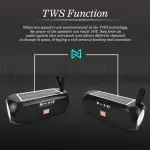
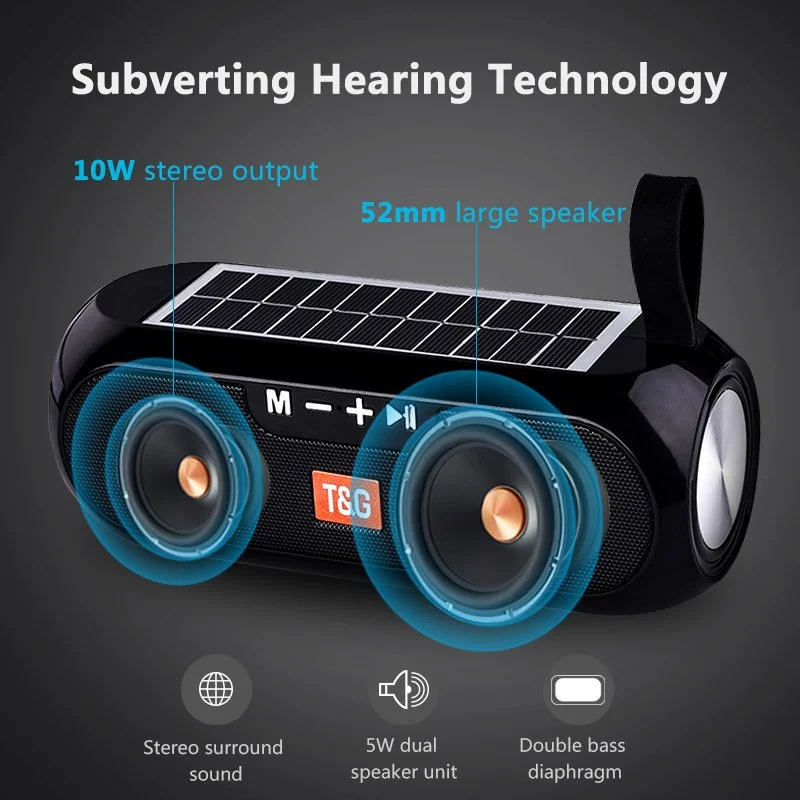
The Solar Boombox (#p-021423, $36.95) is the solar-side recommendation for buyers who want budget outdoor audio with a daylight charging assist.
It fits these jobs:
- Campsite table audio: set it down near the cooking or eating area.
- Tailgate music: useful when the speaker is near the car and group.
- Backyard listening: better presence than many tiny speakers.
- Beach blanket use: useful if protected from sand and water according to its rating.
- Forget-to-charge backup: solar can help when the battery was not perfectly managed.
The key feature is the solar panel, but the right expectation is modest. Treat it as a top-up system. Charge the boombox fully before leaving, then place it in useful daylight when possible. Do not expect a small panel to instantly recover an empty battery.
The boombox format also matters. A larger body can feel more stable on a table and produce more outdoor presence than a tiny pocket speaker. That makes it a better match for group listening than private listening.
The honest limit: at $36.95, this is a budget outdoor speaker, not a premium audio system. It should not be compared with high-end Bluetooth speakers on sound refinement, app features, waterproofing, or tested battery performance unless the exact specs support that comparison.
When a Solar Boombox Is the Wrong Choice
Do not buy a solar boombox if you need music while moving. Hiking, biking, running, paddling, and carry-on travel all favor smaller speakers.
Do not buy it mainly for indoor use. Solar is irrelevant indoors, and the larger body may be less convenient than a compact speaker.
Do not buy it if the speaker will always sit in shade. A solar panel that never gets light is decoration.
Do not buy it as an emergency power system. A speaker-mounted solar panel is not a substitute for a proper power bank, charger, or emergency radio.
Do not assume it is beach-proof without an IP rating. Sand and saltwater are harder on electronics than casual product photos suggest.
Do not expect it to outperform premium Bluetooth speakers simply because it is larger. Sound quality depends on the specific speaker design.
This does not make solar boomboxes weak. It makes the use case clear: stationary outdoor listening with useful daylight and a buyer who values charging forgiveness over pocket portability.
Buying Checklist
Before buying either category, answer these questions:
- Will I carry the speaker all day or set it down?
- Will it sit in direct sun long enough for solar to matter?
- Do I need music for one afternoon or several days?
- How loud do I actually need it to be?
- Will I use it near water, sand, dust, or rain?
- Does it have an official IP rating?
- Do I care more about bass, clarity, volume, or portability?
- Do I need a speaker that can charge my phone?
- Can I charge it fully before leaving?
- Is the product's battery claim realistic for my volume level?
The answer usually becomes obvious. Movement points to Bluetooth. Stationary daylight points to solar boombox. Weather exposure points to IP-rated models. Party volume points to larger speakers. Personal travel points to compact speakers.
FAQ
Is a solar boombox better than a Bluetooth speaker?
Only for certain outdoor uses. A solar boombox is better when the speaker stays in one sunny place for hours, such as a campsite, tailgate, patio, or beach setup. A Bluetooth speaker is better when portability matters.
Can a solar boombox run forever in the sun?
No. Treat solar as a top-up feature, not unlimited power. Output depends on sunlight, panel size, angle, weather, battery size, volume level, and speaker design.
Should I still charge a solar boombox before leaving?
Yes. Charge it fully before the trip. The solar panel should support the battery during use, not replace normal charging.
Do solar speakers work on cloudy days?
Solar panels can produce some power in cloudy conditions, but much less than in direct sun. A small speaker panel should not be expected to recharge quickly on cloudy days.
Is a solar boombox good for camping?
Yes, if it stays near the campsite in daylight and you keep volume respectful. It is useful for tables, tents, tailgates, and group areas. It is not ideal for backpacking or long hikes.
Is a Bluetooth speaker better for the beach?
Often yes if it has a strong IP rating, dust protection, and compact design. A solar boombox can also work at the beach, but only if it is protected from sand and water and is not too bulky to carry.
What IP rating should I look for?
For outdoor use, look for an official IP rating. IPX4 can handle splashes. IPX7 indicates stronger water protection. IP67 or IP68 adds dust protection as well as water protection, depending on the exact standard and product claim.
Does louder mean better?
No. Loudness helps outdoors, but distortion, harsh treble, weak bass, and poor clarity can still make the speaker unpleasant. Judge sound at the volume you will actually use.
Is the Solar Boombox a good budget option?
It can be a good budget option for stationary outdoor use at campsites, tailgates, patios, and sunny picnic setups. It is not the right choice if you want premium audio or a compact speaker for active travel.