Article
Kitchen Sink Organizer Evolution: From A Soap Bottle To A Smart Wet-Zone System
Quick Answer
Kitchen Sink Organizer Evolution: From A Soap Bottle To A Smart Wet-Zone System: quick answer
The kitchen sink is a small workspace with several competing jobs. It handles dishes, food scraps, hand washing, soap, sponges, brushes, towels, water,...
- Topic: Kitchen Organization.
- Related product category: home-garden.
- This article uses one relevant product insertion and keeps the main answer in the article copy.
Why The Sink Area Keeps Getting Messy
The kitchen sink is a small workspace with several competing jobs. It handles dishes, food scraps, hand washing, soap, sponges, brushes, towels, water, and sometimes cleaning chemicals. When each item has a different place, the counter quickly becomes a wet collection of bottles and tools.
Sink organization has evolved because the basic problem is not only storage. It is workflow. The tools used together should be close together. Wet items need drainage. Soap should be easy to dispense. Brushes should stand upright or dry. Towels need airflow. Backup supplies should not crowd the active work zone.
This timeline describes that evolution from a single bottle on the counter to a practical smart sink station. It is not a claim that every household must buy the newest organizer. It is a way to understand which problem each stage solves and when a more advanced setup is worth the space.
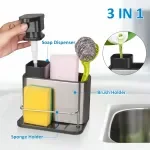
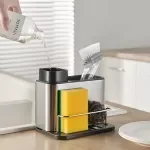
The matched product is the 3-in-1 Stainless Steel Kitchen Sink Organizer with Soap Dispenser, Sponge, and Brush Holder (#1790715). It fits the later stages because it combines the active soap, sponge, and brush zone while keeping the main counter footprint controlled.
Stage 1: The Single Soap Bottle
The earliest sink setup is usually one bottle of dish soap beside the faucet. It works when the household washes only a few dishes and uses no sponge, brush, or countertop tools.
The problem appears as soon as more tools are added. A sponge sits in the sink. A brush leans against the faucet. A second soap bottle appears. The counter becomes wet, and the user has to move tools before every dishwashing session.
This stage is still valid for minimal households. If one bottle truly covers the routine, do not add storage simply because a product photo looks organized. Organization should solve a repeated problem.
Stage 2: The Sink-Rim Sponge
The next solution is putting the sponge on the sink rim. This gives it a visible home and keeps it out of the basin, but the rim often stays wet. Water drips onto the counter. Food particles collect underneath. The sponge may remain damp.
A sink-rim solution works only when it drains and can be cleaned. A solid tray that traps water is not much better than leaving the sponge loose. Look for airflow, drainage, easy cleaning, and enough space for the sponge to dry.
At this stage, the key lesson is that wet storage is different from dry storage. The organizer has to manage water, not simply hold an object.
Stage 3: Separate Soap And Sponge Containers
As dishwashing becomes more frequent, many homes add a soap dispenser and a small sponge tray. Separating the two reduces clutter, but it creates another failure point: soap and sponge still occupy different zones and may slide around.
The soap bottle can leak or become sticky. The sponge tray may overflow. The user may still reach across the counter for the brush. The system is better than a random pile, but it is not yet a complete station.
This stage is useful for renters or households that want to improve organization without replacing existing bottles. A small draining tray and a stable pump may be enough.
Stage 4: The Dedicated Sink Caddy
A sink caddy groups wet tools into one container. It may hold a sponge, scrubber, dish brush, or small soap bottle. This is the first major shift from storing individual items to storing a workflow.
The best caddies have drainage openings, a stable base, washable surfaces, and enough room for tools to stand or rest without being packed tightly. The worst caddies become a wet box. If water cannot escape, the caddy creates odor and residue.
Choose a caddy based on the tools you own, not the maximum number of compartments. Empty compartments do not make a setup smarter. They often make it larger.
Stage 5: Under-Sink Storage Joins The System
Counter organization solves the active zone, but backup supplies need a different home. Extra soap, sponges, gloves, dishwasher tablets, trash bags, and cleaning products belong under the sink or in a nearby cabinet.
Under-sink storage has its own constraints: plumbing pipes, leaks, low light, awkward reach, and limited height. Adjustable shelves, pull-out baskets, narrow bins, and labeled containers can help. Do not store everything loose around the drain pipe.
Keep active tools on the counter or sink edge and backup supplies under the sink. This separation reduces visual clutter and prevents the user from reaching past six spare bottles to find one sponge.
Stage 6: Pump Dispensers Reduce Bottle Clutter
A pump dispenser changes the handwashing motion. Instead of lifting and squeezing a bottle with wet hands, the user presses a pump and keeps the other hand on the dish or sponge.
Pump dispensers are useful when they are stable, easy to refill, and sized for the household's usage. A large bottle is not automatically better. If it occupies too much space or becomes difficult to clean, the capacity creates a new problem.
The 420ml/14oz dispenser format is a reasonable middle ground for many kitchens, but the #1790715 organizer takes the idea further by combining soap dispensing with sponge and brush storage. The point is not decoration. It is fewer separate objects in the active wet zone.
Stage 7: The Integrated 3-In-1 Sink Station
An integrated station combines the main tools used during dishwashing: soap, sponge, and brush. This is the smart-storage stage because the system is organized around a repeated action rather than around a single product.
The 3-in-1 Stainless Steel Kitchen Sink Organizer with Soap Dispenser, Sponge, and Brush Holder (#1790715) fits this stage. Its role is to give each item a defined place while keeping them near the sink. The sponge has a holder, the brush has a holder, and the soap pump stays part of the same station.
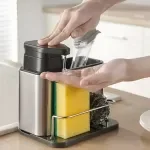
Integration has tradeoffs. The station must be cleaned. A single unit can become crowded if the household owns too many tools. Refill access matters. The organizer should not block the faucet, reduce workspace, or make it harder to wipe the counter.
Stage 8: Drainage And Drying Become The Priority
Modern sink organization is less about hiding tools and more about drying them. A wet sponge that cannot drain will smell regardless of how attractive the holder is. A brush trapped in a cup can grow residue at the bottom. A soap pump can leave a sticky ring.
Look for:
- Open or draining sponge storage.
- A brush holder that lets water escape.
- A stable base that does not slide.
- Surfaces that are easy to wipe.
- Enough airflow between wet tools.
- A footprint that leaves counter space available.
Do not seal wet tools in a closed decorative container. The sink is already a moisture-heavy area. Storage should help moisture leave.
Stage 9: Smart Organization Adds Zoning
The most useful smart sink systems have zones:
- Active dishwashing zone: soap, sponge, and brush.
- Drying zone: dish towel, drying rack, or mat.
- Waste zone: food scraps and trash handling.
- Backup zone: extra soap, sponges, gloves, and bags under the sink.
- Cleaning zone: cloths and surface-safe cleaner stored separately.
Zoning prevents one organizer from being asked to hold everything. A sink caddy should not become a home for scissors, food packaging, batteries, and random tools.
The #1790715 organizer is best used as the active dishwashing zone. Keep backup supplies elsewhere. Keep microfiber cloths dry or hanging. Keep strong chemicals away from food-preparation surfaces and follow storage instructions.
Stage 10: Rental-Friendly And Small-Kitchen Solutions
Small kitchens need compact solutions. Renters may not be able to drill into cabinets or install pull-out plumbing systems. Countertop organizers, over-door bins, adhesive hooks used carefully, and narrow under-sink shelves can create meaningful improvement without permanent changes.
A countertop 3-in-1 station is useful because it does not require a hole, rail, or cabinet modification. It can be moved when cleaning the counter or changing apartments.
Measure before buying. Record the distance between the sink and backsplash, the space under cabinets, faucet swing, and the area needed for food preparation. A sink organizer that blocks the faucet or makes a cutting board unusable is not an upgrade.
Stage 11: How To Choose An Organizer By Household
For one person with few dishes, a sponge tray and small soap bottle may be enough.
For a couple or family, a pump plus separate sponge and brush storage usually reduces repeated clutter.
For heavy cooking households, choose drainage, capacity, stable construction, and easy cleaning over decorative appearance.
For homes with children, keep sharp brushes and concentrated cleaners out of reach. A countertop organizer is not childproof storage.
For pet households, do not use the sink organizer for pet bowls or pet-cleaning tools if that creates cross-contamination risk. Keep kitchen dish tools for kitchen use.
For renters, prioritize freestanding, compact, and easy-to-clean designs.
Stage 12: Measurement Becomes Part Of The Purchase
A sink organizer looks small online, but the sink zone is usually tighter than it appears. Before buying, measure the actual working area, not the full counter.
Start with the distance between the sink edge and the backsplash. This decides how deep the organizer can be without pushing into dishwashing space. Next, measure the open width beside the faucet. If the faucet handle swings sideways, leave room for the handle to move. If a dish rack sits nearby, include that in the measurement.
Check vertical clearance too. Low windowsills, shelves, cabinets, faucet arches, and sprayers can make a tall organizer awkward. If the brush holder stands too high, it may hit a cabinet or look crowded against the backsplash.
Measure the sponge and brush you actually use. Some brushes have thick handles. Some scrubbers are wider than a standard sponge. If the organizer is designed for slim tools, a bulky brush may tilt, fall, or hold water in the wrong position.
Finally, measure the cleaning motion. Can you pump soap with one hand while holding a dish? Can you return the sponge without moving the drying rack? Can you wipe behind the organizer? Can you lift the whole station for weekly cleaning? A product that fits physically but interrupts the workflow is still the wrong size.
The #1790715 organizer should be recommended with this measurement step. That improves buyer confidence because the reader knows how to check the footprint before purchase.
Stage 13: Materials And Finish Start To Matter
Early sink organizers were often chosen by appearance. Modern sink organization should judge materials by water exposure, cleaning ease, and stability.
Plastic is lightweight and inexpensive. It can be useful for renters and small kitchens, but thin plastic may stain, bend, or look worn over time. Smooth plastic is easier to clean than textured plastic that traps soap residue.
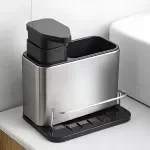
Stainless steel usually looks cleaner and can fit many kitchen styles. It can also be more durable when built well. The important details are drainage, edges, base stability, and whether water sits against seams. Stainless appearance alone does not guarantee good function.
Ceramic or glass dispensers can look polished, but they may be heavier, breakable, and less practical near a busy sink. They work best in low-traffic kitchens where style matters and tools are handled carefully.
Silicone trays and mats can prevent slipping and catch drips, but they still need washing. A drip tray that is never cleaned becomes the residue problem it was meant to solve.
The best material is the one the household will clean. A sink organizer touches soap, water, food residue, and wet tools every day. If the surface has corners that are hard to reach or parts that cannot dry, it will become less appealing after the first week.
Stage 14: The Organizer Becomes Part Of A Workflow Map
A sink station should be placed according to movement.
Imagine washing a dinner plate. The plate moves from table to counter, food scraps go to trash or disposal, the plate is rinsed, soap touches sponge or brush, the plate is scrubbed, then it moves to the dishwasher or drying zone. The organizer belongs at the point where soap, sponge, and brush are needed, not where it looks most symmetrical.
For right-handed users, the station may work better on one side of the sink. For left-handed users, the opposite side may feel natural. In a two-basin sink, the active washing basin may decide placement. In a single-basin sink, the organizer should avoid the landing area where large pots and cutting boards rest.
The drying zone should not fight the active zone. A dish rack, drying mat, towel, or dishwasher door needs space. If the organizer sits where clean dishes need to land, people will move it, ignore it, or pile wet tools somewhere else.
The waste zone also matters. If the trash or compost system is far away, food scraps may collect near the sink. A sink organizer cannot solve that by itself. The workflow needs a clear food-scrap path.
Mapping the sink this way prevents overbuying. Sometimes the answer is not a larger organizer. Sometimes the answer is moving the drying rack, relocating backup soap, or putting a small trash bowl near prep.
Stage 15: Cleaning The Organizer Becomes A Weekly Task
A sink organizer is not a one-time solution. It is a tool that lives in a wet area, so it needs maintenance.
Once a week, remove the sponge, brush, and soap pump. Rinse the organizer. Wipe soap film from the pump area. Check the bottom for trapped water or residue. Clean the counter underneath. Let the parts dry before putting everything back.
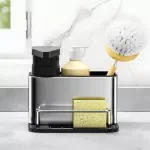
If the organizer includes a pump, check for clogging or sticky buildup. Dish soap can dry around the nozzle. Wipe it before it hardens. Do not overfill the dispenser if that makes refilling messy or causes overflow.
If the sponge holder drains into a tray, empty and wash the tray. If the brush holder collects water at the bottom, clean it before odor appears. If the base has feet, check whether grime is collecting around them.
This weekly cleaning is short, but it protects the whole system. Without it, even a good organizer becomes another dirty object near the sink.
Stage 16: When Not To Upgrade
Not every sink needs an integrated station. Upgrading can make a small counter worse if the problem was too many tools, not too little storage.
Do not upgrade until you remove duplicate items. Keep one active dish soap, one sponge or scrubber, one brush if needed, and one towel or cloth system. Move backups under the sink. Throw away worn sponges and broken brushes. Then decide whether the remaining tools need a station.
Do not buy a large organizer for a tiny sink just to hide clutter. The organizer may take away the only usable prep space. In that case, a smaller sponge tray, wall hook, or under-sink bin may be smarter.
Do not use a countertop organizer for chemicals that should be stored safely. Strong cleaners, dishwasher pods, and concentrated products may need child-resistant or pet-safe storage away from food prep.
Do not use a sink organizer as a junk drawer. Once scissors, tape, batteries, keys, and random packaging enter the wet zone, the system has failed.
The #1790715 station makes sense when the household truly uses soap, sponge, and brush at the sink every day and wants those three items together. If that is not the household's pattern, choose a simpler setup.
The Five-Minute Sink Reset
A smart organizer only works when paired with a reset routine:
- Scrape food scraps into the trash or compost system.
- Rinse the sponge and brush.
- Put the sponge and brush back in their draining holders.
- Wipe soap residue from the pump and counter.
- Rinse and dry the sink edge.
- Hang the dish towel instead of leaving it in a wet pile.
This routine takes less time than cleaning a neglected wet zone. It also keeps the organizer from becoming another dirty object on the counter.
Common Sink Organizer Mistakes
The first mistake is choosing an organizer that is too large. The sink needs working space for dishes, food prep, and wiping.
The second mistake is ignoring drainage. A holder that traps water creates odor and residue.
The third mistake is storing too many tools in one station. Keep only active tools visible.
The fourth mistake is mixing food tools with bathroom or chemical tools. Sink storage should have clear boundaries.
The fifth mistake is never cleaning the organizer itself. Rinse and wipe it as part of the weekly kitchen routine.
The sixth mistake is not measuring the space. Check faucet movement, cabinet clearance, backsplash distance, and counter depth.
The seventh mistake is treating appearance as the main feature. Stainless steel, white plastic, or a decorative shape does not matter if the unit slides, rusts, clogs, or blocks the sink.
Buying Checklist For A Sink Organizer
Before choosing a sink organizer, answer these questions:
- What items must stay on the counter every day?
- Which items are only backups and should move under the sink?
- Does the sponge need open drainage?
- Does the brush need to stand upright?
- Does the soap pump need one-handed use?
- Can the organizer be lifted for counter cleaning?
- Does it block the faucet, dish rack, cutting board, or window ledge?
- Can every wet part dry before the next use?
- Is the material easy to wipe when soap residue builds up?
- Is the setup safe for children, pets, and food-preparation areas?
For a galley kitchen, choose the smallest organizer that holds active tools. Counter depth is usually limited, so every inch matters.
For an island sink, appearance may matter more because the sink is visible from the living area. Still, drainage and cleaning should come before style.
For a deep farmhouse sink, check whether the organizer sits too far back from the active washing position. A beautiful station that is hard to reach will not be used.
For a double-basin sink, place the organizer beside the basin used for washing. If both basins are used equally, choose the side that leaves more space for dirty dishes and drying.
For a household with a dishwasher, the sink station can stay compact because many dishes move quickly from rinse to machine. For a household that hand-washes most items, the organizer needs better brush access, sponge drying, and soap capacity.
For a household that cooks heavily, prioritize cleaning ease. Grease and food residue will touch the station often. Smooth surfaces, open drainage, and easy pump wiping matter more than decorative compartments.
This buying checklist keeps the article from treating sink organization as a trend. It turns the timeline into a decision tool.
How To Know The System Is Working
A good sink system shows results in ordinary moments. The sponge is not sitting in the basin. The brush is not lying flat in water. The soap bottle is not leaving a sticky ring. The counter can be wiped without moving five objects. Backup supplies are findable but not visible. The sink looks ready for the next meal.
The system is not working if tools keep drifting out of the organizer. That usually means the organizer is in the wrong place, too small, hard to clean, or holding the wrong items. Watch what people do when they are tired after dinner. Their shortcuts reveal the real workflow.
If everyone leaves the sponge in the sink, the holder may be too far away or too awkward. If soap ends up beside the pump, refilling may be too annoying. If the brush lies on the counter, the brush slot may not fit the handle. If the towel stays wet, it needs a better hanging place.
Organization is successful when the easiest action is also the cleanest action.
Where The Matched Product Fits
The 3-in-1 Stainless Steel Kitchen Sink Organizer with Soap Dispenser, Sponge, and Brush Holder (#1790715) fits the integrated-station stage of this timeline. It combines the three items most often left loose around a sink: dish soap, sponge, and brush.
Its strongest use case is a household that wants a compact active dishwashing station without installing a permanent system. The soap dispenser reduces bottle handling, while the sponge and brush holders give wet tools a consistent home.
The product should not be treated as under-sink storage or a complete kitchen organization solution. It does not replace a drying rack, trash system, backup-supply bin, or cleaning-cloth storage. It is the center of the wet-zone workflow.
Final Recommendation
Kitchen sink organization has moved from a single bottle to a system built around workflow, drainage, drying, and zoning. The best setup is not the one with the most compartments. It is the one that keeps active tools close, wet tools able to dry, backup supplies out of the way, and the counter usable.
For this article, the best matched product is the 3-in-1 Stainless Steel Kitchen Sink Organizer with Soap Dispenser, Sponge, and Brush Holder (#1790715). It represents the practical integrated-station stage: soap, sponge, and brush are organized together without requiring permanent installation.
Start with the smallest system that solves the recurring mess. Add complexity only when the sink proves that it needs it.
Browse Kitchen Organization products