Article
The Best Dog Raincoat for Small Dogs: What to Look For in 2026
Quick Answer
The Best Dog Raincoat for Small Dogs: What to Look For in 2026: quick answer
The best dog raincoat for small dogs is not the cutest one. It is the one that keeps the dog dry enough for a real walk, fits without rubbing, leaves...
- Topic: Weather Gear.
- Related product category: dog-apparel.
- This article keeps the main answer in the article copy and places relevant product context inside the guide.
Quick Answer: A Good Small-Dog Raincoat Should Keep the Dog Dry, Visible, and Moving Normally
The best dog raincoat for small dogs is not the cutest one. It is the one that keeps the dog dry enough for a real walk, fits without rubbing, leaves the legs free, protects the chest and belly, and makes the dog easier to see in low light.
Small dogs often need rain protection more than large dogs because they sit closer to wet ground. Their bellies, chests, and legs get sprayed by puddles, wet grass, road splash, and mud within minutes. Short-haired dogs, senior dogs, puppies, lean breeds, and dogs with health concerns may also become uncomfortable faster in cold, wet weather. Veterinary guidance from VCA, AAHA, and AKC-linked resources all point to the same practical idea: size, coat type, age, health, temperature, wind, and wetness affect how much protection a dog needs.
For a small dog, a raincoat should do five jobs:
- Block rain better than a fashion jacket.
- Cover the back, chest, and belly without blocking bathroom movement.
- Fit snugly without restricting breathing, walking, or shoulder movement.
- Add visibility with reflective details or bright color.
- Be simple enough that the dog can learn to tolerate it.
The Reflective Waterproof Dog Raincoat Hoodie for Small & Medium Dogs (#p-003105, $68.65) fits the useful middle ground: waterproof coverage, reflective visibility, small-and-medium sizing, and a hooded design for wet walks. It is best for daily neighborhood walks, rainy potty breaks, cold drizzle, wet sidewalks, and owners who want less towel-drying at the door.
The honest limit: a raincoat is not a medical device, not a substitute for shortening walks in dangerous weather, and not the right choice if the dog panics in clothing. It should make normal rainy walks easier, not force the dog into longer exposure.
Why Small Dogs Get Wetter Faster
A small dog does not experience rain the way a tall dog does. The dog is closer to the ground, so water comes from above and below. Rain falls on the back. Road spray hits the belly. Wet grass soaks the chest. Puddles splash the legs. If the dog has short legs, the underside may be wet even when the rain is light.
That is why back-only rain shells often disappoint small-dog owners. They look like raincoats in photos, but they protect the easiest part of the dog to dry: the back. The difficult mess is usually on the chest, belly, and lower legs.
Small dogs can also lose heat faster than larger dogs. VCA notes that small breeds and short-furred dogs may need extra warmth on cold, windy, rainy, or snowy days because they can lose heat quickly. AAHA similarly highlights small-breed dogs, senior pets, and short-coated pets as more sensitive to cold conditions. Wetness makes this more relevant because damp fur insulates poorly, especially when wind is involved.
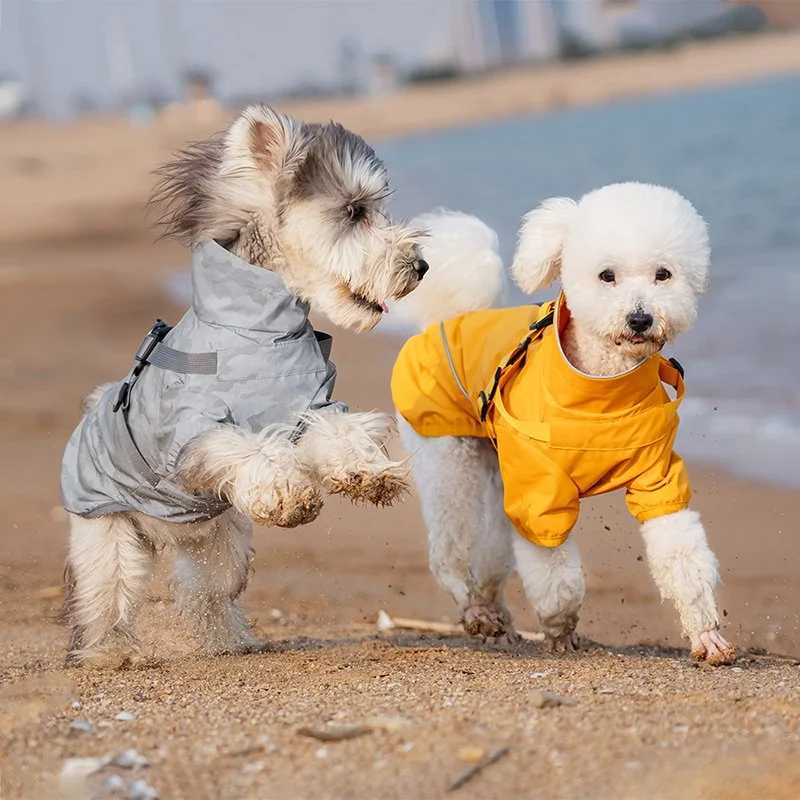
That does not mean every small dog needs a raincoat every time it drizzles. Some dogs have thick coats, tolerate weather well, and dislike clothing. Others refuse to walk in rain until they have protection. The practical test is your dog's behavior:
- Does the dog shiver, stop, lift paws, or try to turn home quickly?
- Does the dog come inside soaked through the belly and chest?
- Does the dog avoid wet grass or refuse bathroom breaks in rain?
- Does the dog take a long time to dry after short walks?
- Does wet weather create a repeated cleaning problem at home?
If yes, a raincoat is not only about style. It is about comfort, cleanliness, and making necessary walks more manageable.
Feature 1: Waterproof Fabric, Not Vague Weather Resistance
The first feature to check is waterproofing.
Many dog jackets use confusing language. "Water-resistant" often means the fabric can handle drizzle or brief exposure but may soak through during steady rain. "Water-repellent" usually means water beads at first, but the protection may weaken with time, wear, dirt, or washing. "Waterproof" should mean the outer material is designed to block rain more seriously, often through coated fabric, laminated material, sealed construction, or a similar water-blocking layer.
For a small dog raincoat, waterproofing matters because the coat may sit close to wet grass and splash zones. A thin decorative jacket can become damp, heavy, and cold. A fleece-lined coat can be warm in dry cold, but if the outer layer absorbs water, the dog may end up wearing a wet blanket.
Look for:
- A waterproof outer shell.
- Smooth fabric that sheds rain.
- Seams and closures that do not obviously channel water inside.
- A design that does not leave the chest completely exposed.
- Cleaning instructions that are realistic for muddy walks.
The #p-003105 raincoat is positioned as waterproof, which is the right starting point for actual rain walks. That does not mean the dog can stay outside indefinitely. It means the coat is built for wet-weather use instead of only looking rainy-day themed.
When comparing products, avoid judging only by photos. A shiny jacket may be water-resistant but poorly shaped. A cute hoodie may absorb water. A heavy lined coat may be too warm for summer rain. The material has to match the walk: light waterproof shell for warm rain, more coverage and warmth for cold rain, and shorter outings in severe weather.
Feature 2: Chest and Belly Coverage
For small dogs, belly coverage is not a bonus. It is one of the main reasons to buy a raincoat.
A back-only raincoat protects the top line of the dog but leaves the chest, belly, and lower body exposed. That may be acceptable for a larger dog in light rain. It is less useful for a small dog walking through wet grass, curbside puddles, muddy sidewalks, or road spray.
Good coverage should include:
- Back coverage from the base of the neck toward the tail.
- Chest coverage where rain and splash hit during walking.
- Belly protection that does not block urination.
- Side coverage that reduces spray from puddles.
- A shape that stays in place when the dog turns, sniffs, or trots.
Bathroom access is the trade-off. A coat that covers everything but blocks peeing will fail immediately. Male dogs may need a different belly cut than female dogs. Long-bodied breeds may need more back length without extra belly fabric. Deep-chested breeds may need adjustable girth room.
Use this home test before depending on the coat:
- Put the coat on indoors.
- Let the dog walk, turn, sit, and lie down.
- Take a short outdoor bathroom break.
- Check whether the dog can squat or lift a leg normally.
- Look for wet spots or rubbing after the walk.
The right raincoat should cover enough to reduce cleanup while still letting the dog behave like a dog.
Feature 3: Fit by Measurement, Not Weight
Small and medium dog sizing is messy. A 12-pound dachshund, a 12-pound pug, and a 12-pound poodle mix may need very different raincoat shapes. Weight alone is not enough.
VCA's dog-jacket guidance recommends measuring the dog's back length from the base of the neck to the base of the tail, the chest around the widest part just behind the front legs, and sometimes the neck circumference. That is the right way to shop because a raincoat must fit the dog's body shape, not just the number on the scale.
Measure three points:
Back length: from the base of the neck to the base of the tail. This decides whether the coat covers the body without hanging too far.
Chest girth: around the widest part of the ribcage, usually behind the front legs. This is often the most important measurement because straps and closures must fit here.
Neck circumference: around the base of the neck where the collar sits, especially if the raincoat has a hood or neck opening.
Then check the product's size chart. Do not assume your dog is always a small or medium. Dog clothing sizes vary by brand, and the same dog may be a small in one product and medium in another.
The fit should be snug but not tight. You should generally be able to fit two fingers under straps or closures. The coat should not pinch the armpits, press into the throat, block shoulder movement, or slide sideways during walking.
Signs the coat is too tight:
- The dog walks stiffly or refuses to move.
- Fabric pulls across the chest.
- The neck opening presses into the throat.
- The dog pants or seems distressed in mild weather.
- Redness appears under straps or leg openings.
Signs the coat is too loose:
- It shifts to one side.
- The back lifts in wind.
- The dog steps through straps.
- The hood falls over the eyes.
- The belly panel hangs into bathroom areas.
The right fit is uneventful. The dog should be able to sniff, walk, trot, turn, and go to the bathroom without needing constant adjustment.
Feature 4: Reflective Details and Color
Rain reduces visibility. Cloudy skies, early sunsets, fog, wet pavement glare, and evening walks all make small dogs harder to see. A small dog is already low to the ground, which puts it outside the direct line of sight for drivers, cyclists, scooter riders, and other pedestrians.
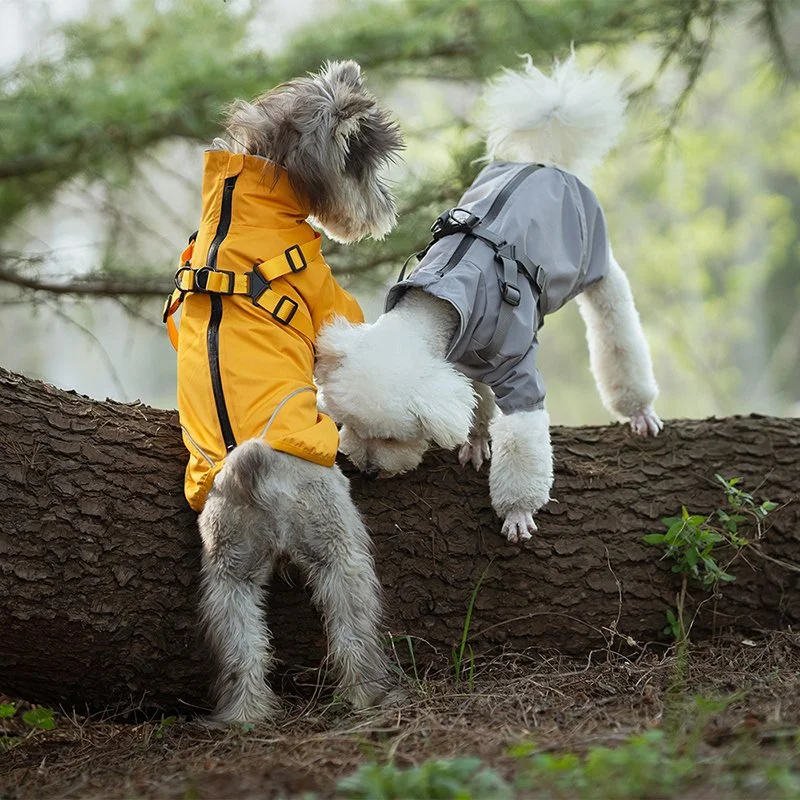
Reflective details are not decoration. They are a safety feature.
Look for reflection in practical locations:
- Across the back.
- Along the sides.
- Near the hood or collar area.
- On the leash opening or harness area.
- On moving edges where headlights can catch the dog from multiple angles.
Bright color also helps in daytime rain. Yellow, orange, red, lime, and other high-contrast colors are easier to spot than black, gray, brown, or navy in wet weather. Reflective strips matter more in headlights; bright color matters more during gray daylight.
The #p-003105 product includes reflective details, which is one of the reasons it fits the small-dog use case. A raincoat without visibility may keep the dog drier, but it misses a major rainy-walk problem.
Owners should still use normal leash safety. A reflective coat does not replace a leash, collar ID, harness, light-up tag, or attention near roads. It simply improves the chance that the dog is noticed.
Feature 5: Hood Design That Does Not Fight the Dog
Dog raincoat hoods are useful only if they stay out of the dog's eyes and the dog accepts them.
Some dogs tolerate a hood well. Others freeze, shake, paw at it, or refuse to walk. A hood that protects the ears and top of the head may be helpful in steady rain, but a floppy hood can become a problem if it blocks vision, traps sound, rubs the ears, or slides over the face.
A good hood should:
- Sit behind or around the ears without forcing them down painfully.
- Stay clear of the eyes.
- Move with the dog's head.
- Be easy to fold back when not needed.
- Avoid heavy fabric that becomes annoying when wet.
If your dog hates hoods, do not force the issue. Use the hood down or choose a no-hood raincoat. Protecting the torso is usually more important than covering the head. Many dogs prefer a coat that leaves the head free but keeps the body dry.
The hoodie design of #p-003105 is useful for dogs that tolerate extra head coverage. The owner's job is to test it calmly before a long rainy walk.
Feature 6: Harness and Leash Compatibility
A raincoat can be waterproof, reflective, and well fitted, then fail because it does not work with your leash setup.
Before buying, check whether your dog walks on:
- A collar.
- A back-clip harness.
- A front-clip harness.
- A step-in harness.
- A vest harness.
Some raincoats have a leash opening at the back. That can work with a back-clip harness or collar, depending on placement. But if the opening does not line up with your dog's harness ring, you may end up pulling the coat sideways. If the raincoat is worn over a bulky harness, the fit may become tight. If it is worn under a harness, the harness may compress the coat and reduce coverage.
The safest approach is to test the full walking setup:
- Put on the harness or collar as usual.
- Put on the raincoat in the intended order.
- Attach the leash.
- Walk around indoors.
- Check whether the leash pulls fabric into the neck or shoulders.
- Check whether the dog can turn without the leash catching the hood.
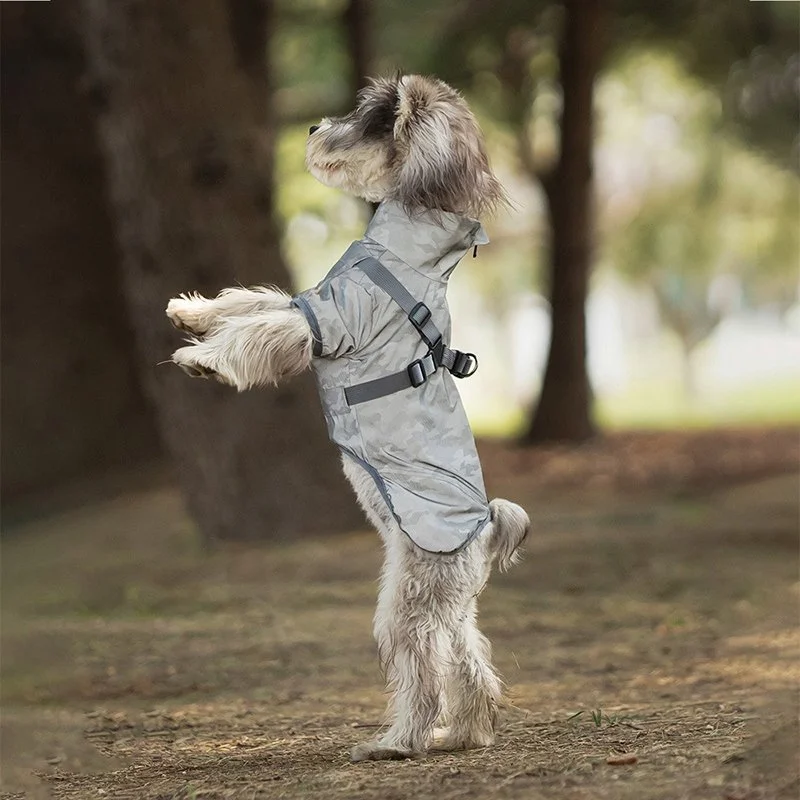
If your dog uses a front-clip harness, many raincoats are less convenient. You may need a coat that sits cleanly under the harness or a harness-compatible design. Do not compromise leash control for rain protection.
Feature 7: Easy On and Off
The best raincoat is the one you can put on quickly when the dog actually needs to go outside.
Rainy potty breaks are not the time for complicated straps, sleeves, snaps, and wriggling. If the coat takes too long, the owner gets frustrated and the dog learns to avoid it.
Good small-dog raincoat designs usually have:
- A simple neck opening or wrap style.
- One or two belly straps.
- Adjustable closures.
- No tight leg sleeves unless the dog is used to clothing.
- Hardware that can be handled with wet hands.
Some dogs dislike over-the-head clothing. For those dogs, a wrap-around coat may be easier. Other dogs tolerate step-in or sleeved jackets well. Match the closure style to the dog's temperament, not just the product photo.
Introduce the raincoat before the first storm. Put it near the dog. Let the dog sniff it. Try it for a short indoor session. Reward calm behavior. Remove it before the dog becomes frustrated. Build up to a short dry-weather walk before using it in heavy rain.
This training step matters because a dog that panics in the coat may walk awkwardly, refuse to relieve itself, or create more stress than the rain would have caused.
Weather Matching: Raincoat, Sweater, or No Coat?
Different weather calls for different gear.
| Weather | Best Choice | Why |
|---|---|---|
| Warm light rain | Lightweight waterproof raincoat | Keeps dog dry without trapping too much heat |
| Cold rain | Waterproof raincoat with some warmth or a layer system | Wet plus cold can chill small or short-haired dogs quickly |
| Dry cold | Sweater or insulated jacket | Warmth matters more than waterproofing |
| Heavy storm | Short bathroom break, not a long walk | Gear should not encourage unsafe exposure |
| Snow and slush | Waterproof coat plus paw care | Belly and paws need protection from wet, cold, salt, and ice |
| Hot humid rain | Very light shell or no coat | Overheating can be a bigger risk than getting wet |
AAHA warns that pets can face serious winter risks including hypothermia and frostbite in freezing conditions, while VCA notes that dampness, rain, sleet, wet snow, and windchill can create risk. Those sources are about cold safety, but they are useful when choosing rain gear because wet weather is not only a cleaning problem. It can become a comfort and safety problem when temperatures drop.
Also watch for overheating. A waterproof layer can trap heat, especially during warm rain or active walks. If the dog pants heavily, slows down, seeks shade, drools, or seems distressed, remove the coat and shorten the walk.
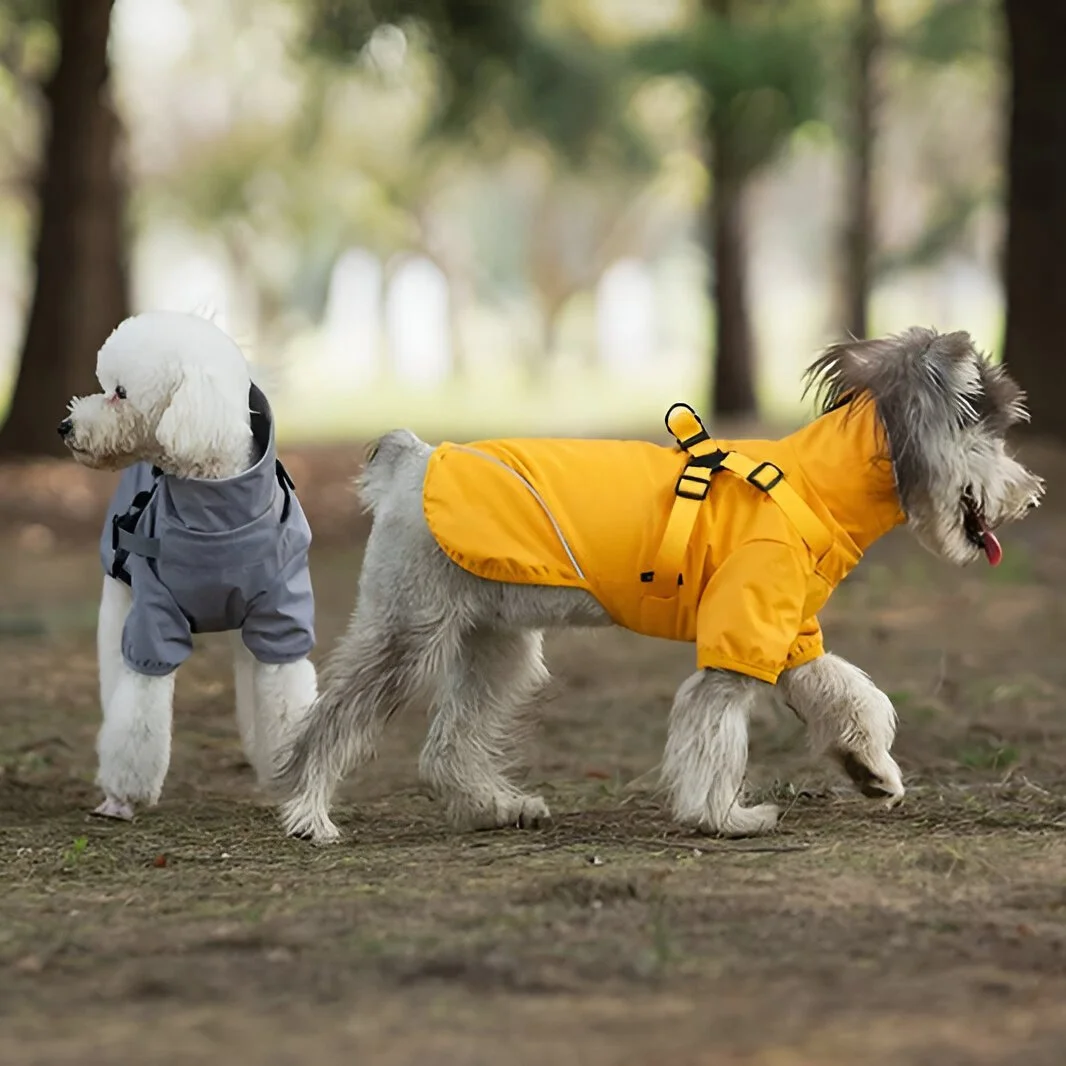
The right question is not "Does my dog need a raincoat?" The right question is "Does my dog need this coat for this weather and this walk?"
What Not to Buy
Avoid raincoats that solve the wrong problem.
| Skip This | Why It Fails |
|---|---|
| Back-only fashion cape | Leaves the chest and belly wet on small dogs |
| Water-resistant jacket for steady rain | May soak through during real walks |
| No reflective details | Makes the dog harder to see in low light |
| One-size-fits-all design | Usually fits too many dogs badly |
| Thick absorbent fabric as an outer layer | Can hold water and chill the dog |
| Hood that covers the eyes | Creates stress and poor visibility |
| Coat that blocks bathroom movement | Dog will reject it quickly |
| Complicated closures | Slows down rainy potty breaks |
| Tight leg sleeves for a clothing-sensitive dog | Can restrict movement and increase refusal |
| Heavy coat for warm rain | Raises overheating risk |
The product should support the walk. If the dog is less comfortable, less mobile, or less safe, the raincoat is not doing its job.
The Pick: Reflective Waterproof Dog Raincoat Hoodie
The Reflective Waterproof Dog Raincoat Hoodie for Small & Medium Dogs (#p-003105, $68.65) is best framed as a practical daily raincoat for small and medium dogs that still need to walk in wet weather.
It checks the important boxes:
- Waterproof protection: built for rain rather than only drizzle styling.
- Reflective visibility: useful for cloudy, early-morning, evening, and street-side walks.
- Hoodie design: adds head and ear coverage when the dog tolerates it.
- Small and medium sizing: aimed at the dogs most likely to need help with wet-weather comfort.
- Clean daily function: reduces wet fur, mud, and towel work after short walks.
The best buyer is an owner of a small or medium dog that still needs regular outdoor walks in rain, drizzle, wet sidewalks, or cool weather. It is especially relevant for short-haired dogs, low-to-the-ground breeds, senior dogs, and dogs that come home soaked from normal bathroom breaks.
The honest limits:
- It may be too much for hot summer rain if the dog overheats easily.
- Some dogs will not tolerate a hood.
- It must be measured carefully; small and medium labels are not enough.
- It does not replace paw wiping, leash safety, or short walks in severe weather.
- It is not needed for every dog, especially thick-coated dogs that tolerate wet weather well.
At $68.65, it is not the cheapest rain shell. The value depends on use frequency. If your dog only steps outside under an awning twice a month, a simpler coat may be enough. If your dog walks daily and rain creates repeated mess, discomfort, and drying time, a more functional waterproof and reflective raincoat makes sense.
First-Walk Setup Checklist
Use the first rainy walk as a test, not a full outing.
Before the walk:
- Measure the dog and adjust straps indoors.
- Check that two fingers fit under closures.
- Attach the leash and confirm the harness or collar works.
- Fold the hood back if the dog seems uncomfortable.
- Check that the coat does not cover bathroom areas.
- Keep the first walk short.
During the walk:
- Watch the dog's gait.
- Check whether the coat slides sideways.
- Notice whether the dog can sniff and turn normally.
- Watch for shivering, refusal to walk, paw lifting, or distress.
- Watch for overheating if the weather is warm.
After the walk:
- Remove the coat promptly indoors.
- Dry paws, belly, and ears as needed.
- Check for rubbing under straps.
- Hang the coat to dry before storing.
- Wipe mud from closures so they keep working.
This routine turns the coat into part of normal dog care instead of a one-time costume.
FAQ
Do small dogs really need raincoats?
Some do, some do not. Small, short-haired, senior, young, lean, low-to-the-ground, or cold-sensitive dogs often benefit most. Thick-coated dogs that tolerate rain well may not need one for short outings.
Is waterproof better than water-resistant for a dog raincoat?
For steady rain, yes. Water-resistant fabric may be fine for drizzle, but waterproof material is the better choice for real rain walks, wet grass, and splash.
Should a dog raincoat cover the belly?
For small dogs, belly coverage is very useful because the underside gets wet from grass, puddles, and sidewalk splash. The coat still needs to allow bathroom movement.
How do I measure my dog for a raincoat?
Measure back length from the base of the neck to the base of the tail, chest girth behind the front legs, and neck circumference if needed. Compare those numbers with the specific product size chart.
Are hoods good for dogs?
Only if the dog tolerates them and the hood stays out of the eyes. Many dogs prefer the hood folded back. Torso coverage is usually more important than forcing head coverage.
Can a dog overheat in a raincoat?
Yes. Waterproof layers can trap heat, especially in warm humid rain. Watch for heavy panting, drooling, slowing down, or distress, and remove the coat if needed.
Should I use a harness under or over the raincoat?
It depends on the coat and harness. Test the full setup indoors. The leash should attach cleanly without pulling fabric into the neck or shoulders.
What if my dog freezes when I put on the coat?
Introduce it gradually with short indoor sessions and rewards. If the dog remains distressed, choose a simpler design or skip the coat for short bathroom breaks.
Does a raincoat replace paw care?
No. In wet, icy, or salted conditions, wipe paws after walks and check for irritation, debris, or cracked pads.