Article
The 6 Best Throw Pillow Covers by Style (2026 Buyer's Guide)
Quick Answer
The 6 Best Throw Pillow Covers by Style (2026 Buyer's Guide): quick answer
Pillow covers are one of the easiest ways to change the color, texture, and mood of a room without replacing the sofa or its inserts. They are also...
- Topic: Best.
- Related product category: home-decor.
- This article keeps the main answer in the article copy and places relevant product context inside the guide.
Why Pillow Covers Are the Cheapest Room Refresh You Can Buy
Pillow covers are one of the easiest ways to change the color, texture, and mood of a room without replacing the sofa or its inserts. They are also low-commitment: a cover can be swapped seasonally, washed when needed, and stored flat when it is out of rotation. The key is to treat covers as a small styling system rather than a random collection. Choose a base color that works with the sofa, add one texture or pattern, and use inserts that match the cover's stated dimensions. The change is quick, reversible, and easier to adjust than a larger furniture purchase. The catch is that "pillow covers" are a minefield of choice: material (velvet, linen, chenille, jacquard, cotton), size (16, 18, 20, 22 inches), closure (zipper, envelope, button), and style (boho, minimalist, traditional, modern). Most people buy the first cute cover they see and end up with a pillow that clashes with the sofa, sheds on the couch, or doesn't fit the insert they already own. This guide breaks down six throw-pillow-cover styles so you can match the cover to the room instead of guessing. The examples use the catalog's listed dimensions and materials; 18 x 18 inches is common, but not universal, so always match the cover to your insert before ordering.
1. Romantic & Personalized: The Love Letter Jacquard
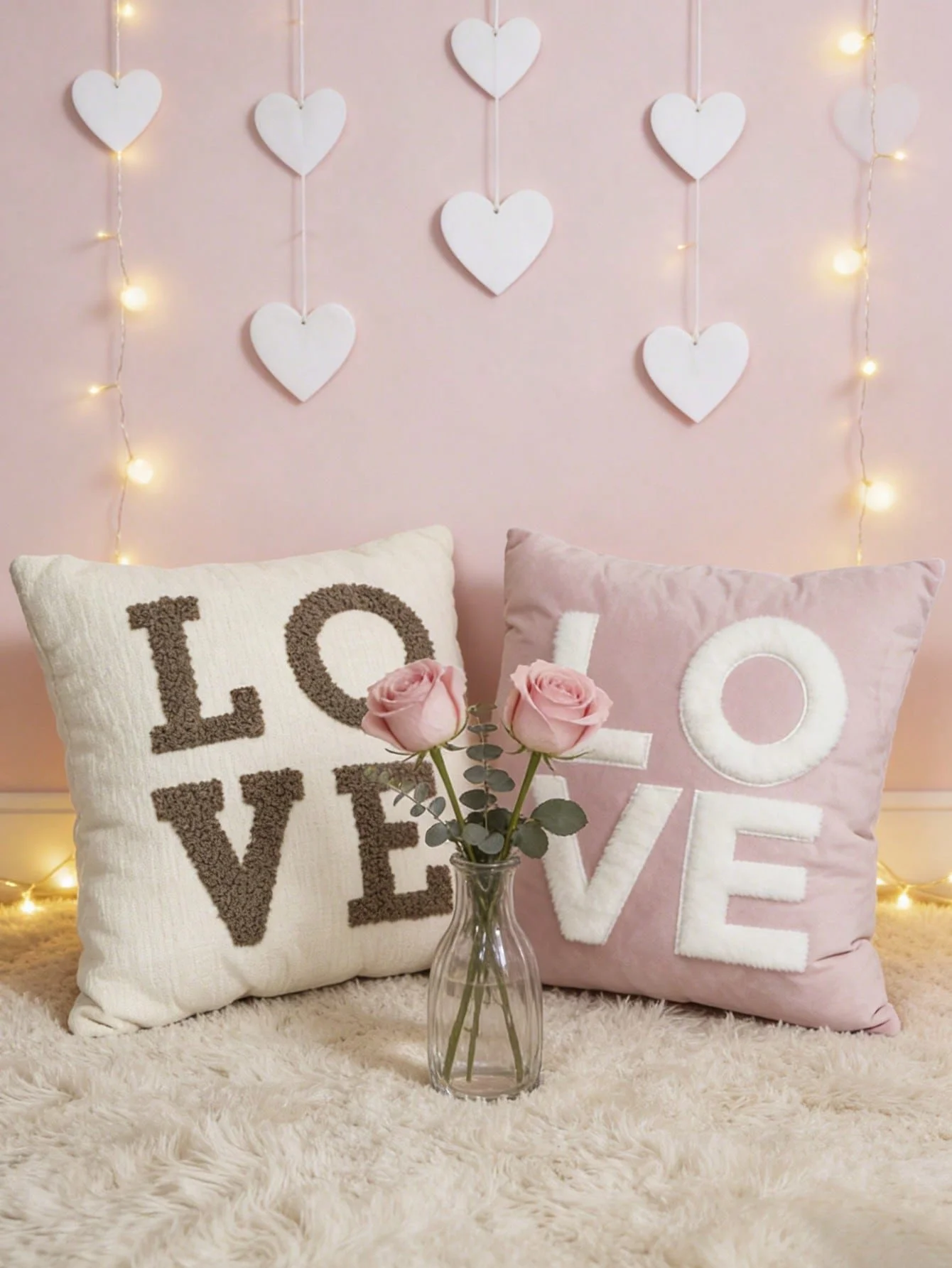
If your room leans soft, warm, and personal - blush tones, floral prints, framed photos - the romantic style is your lane. The Love Letter Jacquard Pillowcase with Zipper ($17.95) is listed as a jacquard-woven cover with a love-letter motif that reads romantic without tipping into saccharine. Why this style works: jacquard gives you a pattern with depth because light catches the raised weave differently than the flat background. The zipper closure means you can remove the cover from the insert, and the listing should be checked for exact size and care instructions. This is the pick for bedrooms, reading nooks, and anyone who wants a softer sofa accent. On the jacquard-vs-printed question, the difference that matters is construction. A printed cover places the design on the surface of the cloth. Jacquard uses the weave itself to create the pattern. That can make the texture feel richer, but long-term durability still depends on fiber content, wash method, sun exposure, and stitch quality. For placement: two in a bedroom against Euro shams with a knit throw at the bed's foot; one solo on a wingback in a reading nook; or one in front of a solid velvet in a deeper blush tone on a neutral sofa, so the motif gets a frame. Follow the product care label for washing and drying. Match it with: soft neutral sofas, blush and cream palettes, other textured textiles (knit throws, velvet cushions). Avoid if: your room is industrial, minimalist-black, or full of sharp geometric prints — the love letter motif will fight the vibe.
2. Modern & Geometric: The Jacquard Plush
Modern rooms (clean lines, gray or beige sofas, metal accents) need pillows that are geometric but not cold. The Modern Jacquard Plush Decorative Pillow Cover ($26.49) splits the difference: a jacquard geometric pattern in plush fabric — soft to the touch, structured in appearance. The plush material is the differentiator here. A modern room with hard edges (glass tables, metal legs, concrete floors) can feel cold; plush pillows can soften that look. The geometric jacquard keeps it structured, and the neutral tones can work with gray, beige, white, and navy sofas. The construction deserves a closer look: plush is a short-pile fabric with a softer hand than many flat weaves. A geometric woven pattern can add structure without relying only on printed color. Check the product page for fiber content and cleaning guidance, because plush covers can vary a lot by manufacturer. Style it as the modern living-room workhorse: three on a gray sectional (two corners, one center), or two on a beige sofa with a bouclé lumbar in front. It also works in a home office — one on the desk chair keeps it from feeling like a conference room. The neutral tones bridge gray, beige, white, and navy without demanding a color-matched room. Match it with: gray/beige sofas, metal and glass furniture, monochrome art. Avoid if: your room is already soft and floral — this one would add structure where you don't need it.
3. Easy-Clean & Family-Friendly: The Chenille Solid
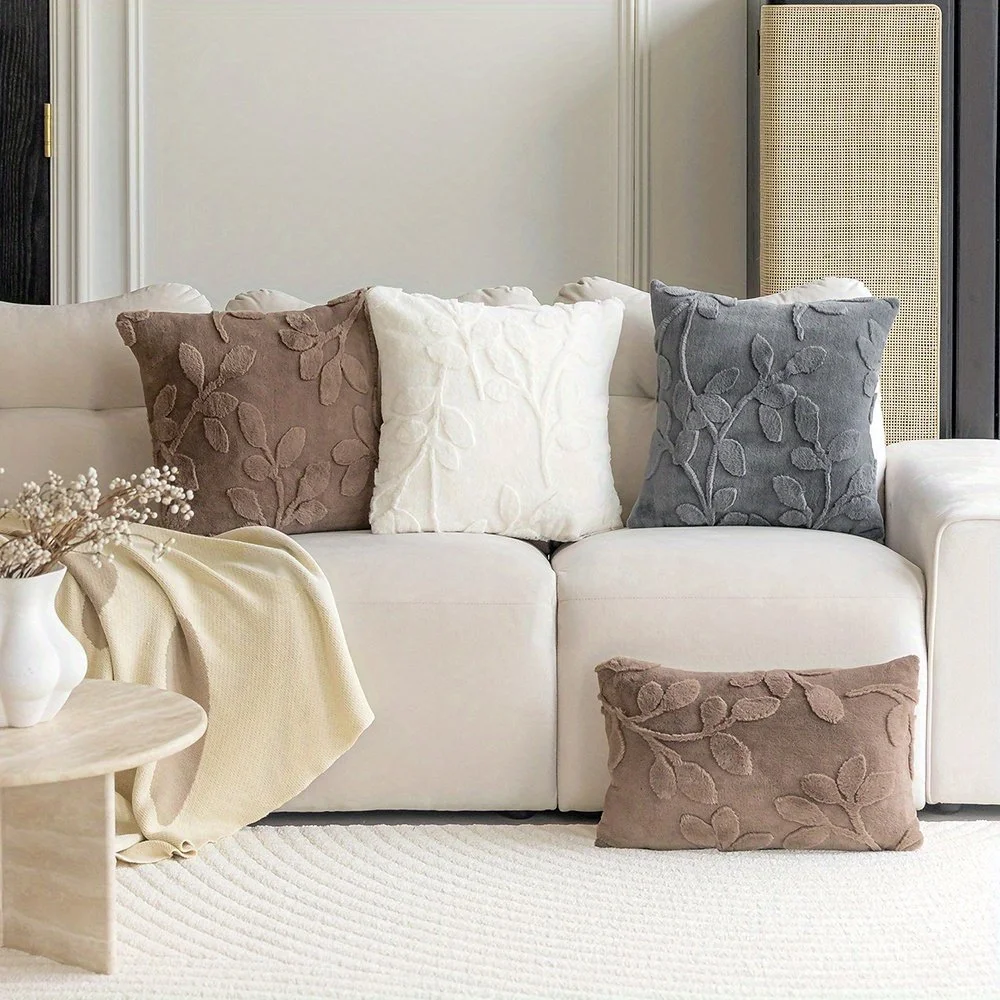
This is the pick for the family room - the couch where kids jump, pets sleep, and snacks happen. The Easy-Clean Modern Solid Color Chenille Sofa Cushion Cover ($32.99) is a solid-color chenille cover, which makes it a practical base layer for rooms that need a soft but understated pillow. The "easy-clean" wording should still be verified against the seller's care instructions. In general, solid-color chenille can hide everyday texture and lint better than very smooth fabrics, and it works in many rooms because it is a neutral solid. You can dress it up with a patterned pillow in front of it or let it carry the couch alone. On durability, the honest version: chenille yarns are short tufted fibers twisted around a core. They can feel soft, but loose fibers may shed or pill at high-friction spots like armrest corners. If machine washing matters to you, confirm the care label before buying. For the family room, style it as the base layer: three solids across a sectional, with a patterned lumbar in front of the center one when company's coming. In a game room or sunroom it can carry the whole sofa alone. Pet households may appreciate the textured surface, though fur visibility depends on the pillow color and pet hair color. Match it with: literally anything — it's a neutral solid. Family rooms, sunrooms, game rooms. Avoid if: you want the pillow to be the statement piece (it's not; it's the workhorse).
4. Boho & Earthy: The Grid Stripe Cotton Linen
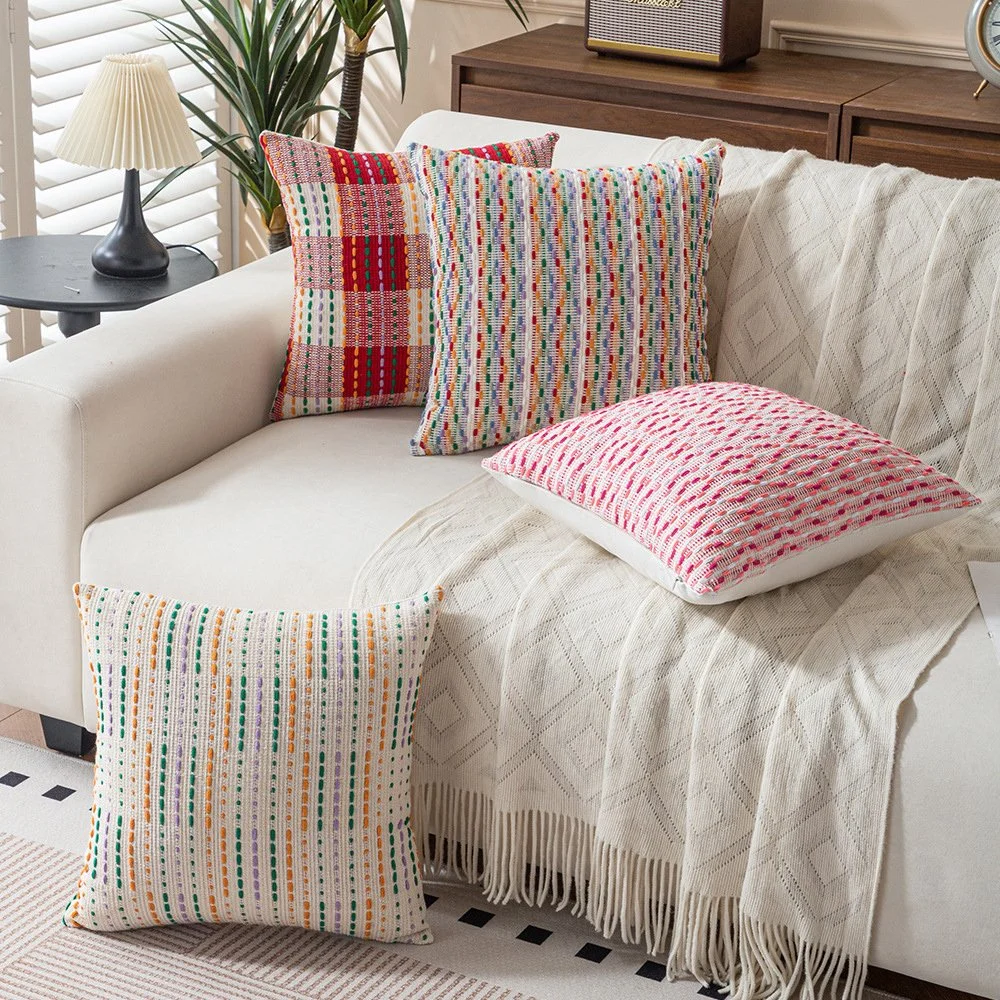
Boho style (macramé, rattan, warm earth tones, plants everywhere) needs texture above all — flat, shiny fabric kills the boho vibe instantly. The Boho Jacquard Grid Stripe Cushion Cover 18x18 Cotton Linen ($41.49) delivers the two materials boho demands: cotton linen blend (breathable, matte, slightly slubby) with a jacquard grid-stripe pattern in earthy tones. Cotton linen is useful in boho rooms because it usually reads matte rather than shiny, which makes colors look natural and warm. The grid stripe pattern adds structure without breaking the organic feel, and linen's wrinkle texture can fit the lived-in look. This cover pairs with rattan chairs, jute rugs, wood tones, and plant-heavy rooms. Breathability depends on the exact fiber blend, so check the product page rather than assuming a standard linen feel. On the blend ratio: cotton-linen covers vary widely, so use the product page rather than assuming a standard percentage. Linen can add a matte, textured look, while cotton can soften the hand feel and make care easier. The jacquard grid gives the organic texture more structure, which helps the cover work in an earthy or boho room. It earns its place in three rooms: a boho living room with rattan and jute, a bedroom with wood tones and terracotta, and a sunroom where matte texture feels more natural than shine. Don't iron the wrinkles if the lived-in crease is the look you want. Follow the seller's care instructions for washing and drying. Match it with: rattan, jute, wood tones, terracotta and sage accents, lots of plants. Avoid if: your room is minimalist-white or modern-gray — the earthy tones will look like a mistake against cool palettes.
5. Luxury & Classic: The French Velvet Ruffled Edge
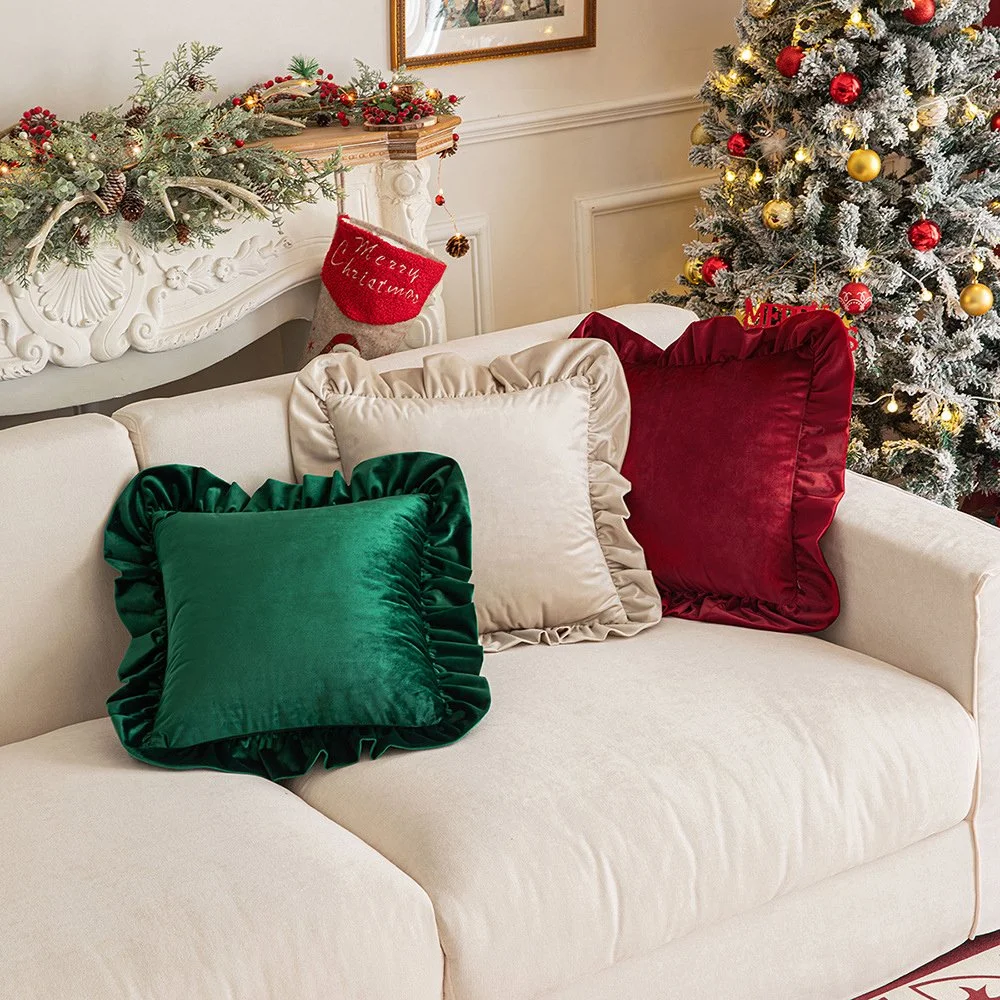
For the room that's meant to feel elegant — a formal living room, a primary bedroom, a reading room with a wingback chair — velvet is the answer, and ruffled-edge velvet is the classic. The French Velvet Ruffled Edge Throw Pillow Cover ($47.49) is 18x18 velvet with a gathered ruffle on all four edges, the kind of pillow you see in hotel lobbies and French-country catalogs. Velvet is often chosen for formal rooms because it catches light and gives a sofa a more styled look. The caveat: velvet can show pet hair, crumbs, and hand oils more than lower-pile fabrics. That is why this is the formal pick, not the family-room pick. The ruffled edge also means it looks best in odd numbers on a sofa - one solo in a reading chair, or three on a sofa with the ruffle breaking up the line. Velvet's pile is the whole story: cut fibers stand upright, and light reflects differently depending on which way the nap brushes. Denser pile can feel richer and may hold its look better, but pile wear depends on fiber, use, and cleaning. The gathered ruffle adds visual volume, so it is better for styled rooms than heavy daily lounging. Where it shines: a formal living room with a cream sofa and brass lamps, a primary bedroom against a tufted headboard, or one solo in a wingback chair. Care is the trade-off: check whether the seller recommends spot cleaning, machine washing, or dry cleaning before ordering. Match it with: cream/beige/gold sofas, dark wood, brass accents, formal rooms. Avoid if: kids, pets, or daily naps live on the sofa — velvet will fight you.
6. Statement & Nordic: The Bronzing Plush
The modern-trendy room — the one with the arched mirror, the bouclé chair, the gallery wall — wants a pillow that's a *statement*, and the Nordic Luxury Bronzing Plush Decorative Cushion Cover 18x18 ($17.95) delivers it: plush velvet-adjacent fabric with a bronzing effect (metallic sheen in the weave) that catches light with every shift. Bronzing is a trend-friendly finish because it catches light and adds a metallic accent without requiring a gold vase or brass lamp. This is the pillow you pair with a boucle chair or a dark-green sofa when the room needs a small statement piece. It is also one of the lowest-priced items on this list at $17.95. On the bronzing effect: the product listing should clarify whether the sheen comes from metallic yarn, surface finish, or another construction. The effect shifts with the light, which is why this style works best where a lamp, window, or mirror can catch it. Confirm care guidance before washing, because metallic-looking finishes can be more sensitive than plain fabrics. Place it where light moves: one on a bouclé chair beside an arched mirror, two on a dark-green sofa under a lamp, or one on a bench at the foot of the bed to catch morning sun. It photographs beautifully, so it's the pillow for rooms that show up on camera — office backdrops, entryway vignettes, gallery-wall corners. Wash cold on gentle, skip fabric softener (it dulls the metallic finish), and air-dry to keep the pile springy. Match it with: bouclé, dark green/navy/black sofas, arched mirrors, gallery walls, gold accents. Avoid if: your room is full rustic-farmhouse — bronzing reads modern and will clash with barnwood and galvanized metal.
Style-to-Room Quick Match Table
| Your room style | Best pick | Price | Material |
|---|---|---|---|
| Romantic / personal | Love Letter Jacquard | $17.95 | Jacquard woven |
| Modern / geometric | Modern Jacquard Plush | $26.49 | Plush jacquard |
| Family / everyday | Chenille Solid (Easy-Clean) | $32.99 | Chenille |
| Boho / earthy | Grid Stripe Cotton Linen | $41.49 | Cotton linen |
| Luxury / classic | French Velvet Ruffled Edge | $47.49 | Velvet |
| Modern-trendy / statement | Nordic Bronzing Plush | $17.95 | Bronzing plush |
Material Comparison Deep Dive
If you remember one thing from this guide, make it this: fabric and fit determine much of whether a cover works for you. The table compares common expectations for velvet, cotton linen, chenille, and jacquard, but the seller's fiber label and care instructions should make the final decision.

| Material | Washability | Shedding | Heat | Longevity |
|---|---|---|---|---|
| Velvet | Often needs gentle care; check ruffled trims carefully | Depends on pile density and fiber | Usually warmer than flat weaves | Can look elegant, but may show friction wear |
| Cotton linen | Often washable, but wrinkles are part of the look | Usually low, depending on blend | Often cooler than plush fabrics | Can age well if the blend and stitching are good |
| Chenille | Check whether machine washing is allowed | Can pill at high-friction corners | Medium; plush but not as heavy as velvet | Practical for daily rooms when care is simple |
| Jacquard | Care depends on base yarn | Usually lower than pile fabrics | Depends on the base yarn | Woven patterns can keep texture, but durability varies |
Two caveats at checkout. First, read the fiber content label — a "linen" cover that's mostly polyester doesn't breathe like linen, and a "velvet" that's actually a polyester knit will shed for months. Second, blend materials instead of buying six of the same: a cotton-linen pair, a chenille pair, and a velvet or jacquard pair give texture, contrast, and a built-in seasonal rotation — the real answer to the $60 refresh.
Size and Insert Guide
Pillow covers are simple only if the cover and insert match. Before buying, unzip one pillow you already own and check the insert tag. If the tag is missing, measure across the insert while it is lying flat. Do not measure corner to corner diagonally; measure width and height. An 18x18 cover is the common choice for standard sofas, accent chairs, beds, and small benches. It is easy to layer and does not overpower a compact couch. A 20x20 cover works better on deeper sofas, sectionals, and beds where the pillow needs more visual weight. A lumbar cover works in front of square pillows or on a desk chair, dining bench, or reading chair. If your insert is thin or tired, a new cover will not fix the shape. The pillow will still look flat. In that case, replace the insert first or buy a cover slightly smaller than a plush insert only if the product materials can handle a fuller fit. If the cover fabric is delicate, heavily textured, or trimmed with ruffles, forcing an oversized insert can stress the seams or zipper. For a polished look, use this approach:
- One chair: one statement cover.
- Small sofa: two matching solids plus one patterned or textured accent.
- Standard sofa: three pillows, with the strongest style in the center or one corner.
- Sectional: five pillows, mixing two solids, two textures, and one statement piece.
- Bed: two larger square pillows behind one decorative accent or lumbar pillow.
The goal is not to fill every inch. The goal is to create a clear color and texture rhythm.
Room-by-Room Styling Recipes
For a neutral living room, start with the Modern Jacquard Plush or Chenille Solid as the base. Add the Nordic Bronzing Plush only if the room needs a highlight. This works well with gray, beige, navy, or cream sofas because the base stays quiet and the metallic effect becomes the accent. For a family room, use the Chenille Solid first. It is the most practical visual anchor in this list because it does not demand a formal setting. If you want contrast, add one Modern Jacquard Plush cover instead of mixing several busy patterns. A family room usually looks better with texture than with too many prints. For a bedroom, the Love Letter Jacquard and French Velvet Ruffled Edge are stronger choices. Bedrooms can handle softer, more romantic details because the room is already personal. Pair one patterned cover with one solid cover so the bed does not become visually crowded. For a boho or plant-heavy space, the Grid Stripe Cotton Linen cover should lead. It works because the matte fabric and grid pattern echo rattan, jute, wood, baskets, and terracotta. If the room already has many plants and woven textures, keep the other pillows simple so the sofa does not look busy. For a small apartment, choose fewer covers and stronger contrast. One solid chenille cover plus one patterned jacquard cover can do more than five pillows in similar colors. Small rooms need breathing space, so avoid overfilling the sofa just because pillow covers are affordable. For a home office backdrop, choose one pillow that reads clearly on camera. The Modern Jacquard Plush and Nordic Bronzing Plush are the strongest options because texture and sheen can show up behind a desk without needing a full room redesign.
Checkout Questions to Prevent Returns
Before ordering, answer these:
- Does the cover size match the insert I own or plan to buy?
- Is the listing for the cover only, or cover plus insert?
- Does the material fit the room's job: formal, family, bedroom, office, or seasonal?
- Can I clean it the way this household actually cleans textiles?
- Will this color still work if the room changes slightly?
- Does the zipper, trim, or ruffle look practical for the intended use?
These questions matter more than the product photo. Pillow covers are close-contact home goods; they are touched, leaned on, washed, stored, and rotated. A good cover fits the room visually and fits the household practically.
How to Buy Pillow Covers Without Regret: 4 Rules
Rule 1: Match the material to the room's job, not the room's vibe. Velvet looks amazing and shows everything. Linen looks natural and needs ironing-adjacent tolerance for wrinkles. Chenille hides life. Decide what the room is *for* before you decide what it looks like. Rule 2: Check your insert size before you buy. Most covers are 18x18 or 20x20. A 20x20 cover on an 18x18 insert looks saggy; an 18x18 cover on a 20x20 insert won't close. Measure what you own first. Rule 3: Buy covers, not pillows, for existing inserts. If you already have throw pillows, buy covers and swap them — it's a $15-45 refresh instead of a $60-100 pillow purchase, and covers store flat for seasonal swaps (this is exactly how the "two looks per year" trick works). Rule 4: Buy odd numbers for styling. Designers style sofas with 3 or 5 pillows (odd numbers feel intentional; even numbers feel symmetrical-and-stiff). If you're buying six covers, split them across two rooms or buy 3+3 in complementary styles.
FAQ
Q: What's the most durable pillow cover material? A: For a daily-use sofa, chenille is a practical place to start because it is soft, textured, and usually less formal than velvet. Still, durability depends on fiber content, stitch quality, and the care label. Q: Can I machine-wash jacquard pillow covers? A: Sometimes, but do not assume. Check the product care label first. Many jacquard covers can handle gentle care, but fiber content and trim details matter. Q: What size pillow cover should I buy for a standard throw pillow? A: 18x18 is common, and 20x20 is common for larger statement pillows. Buy the cover that matches your insert size exactly; even a small mismatch can make the pillow look saggy or overstuffed. Q: How many throw pillows should a sofa have? A: Three is a simple starting point for a standard 3-seat sofa, and five can work on a large sectional. If you're not sure, buy three and add another only if the sofa looks sparse. Q: Do velvet covers shed? A: Some do, especially lower-density or velvet-look knits. Check reviews, fiber content, and care guidance before buying. Price alone is not enough to prove quality. Q: What's the cheapest way to change a room's feel? A: Swap pillow covers first, then consider a throw blanket if the room still feels flat. These pieces change the color and texture people notice at sofa level without replacing furniture. Q: Should I rotate pillow covers seasonally? A: It can help if you like changing the room without buying new furniture. Lighter matte fabrics often suit spring and summer; velvet, chenille, and plush can feel more seasonal in fall and winter. Q: How should I store off-season pillow covers? A: Wash and dry them completely (damp storage starts mildew), then fold flat or roll — never vacuum-seal velvet, which crushes the pile, and skip plastic bags, which trap moisture. A cotton bin or breathable bag with a cedar sachet keeps them fresh. Storing flat means a whole seasonal set fits in one drawer. Q: Should I replace the cover or the insert first? A: Start with the cover if the insert still holds shape. Replace the insert when it becomes lumpy, flat, or creased enough that a new cover still looks tired.