Featured Buying Guide
The 6 Best Coffee Mugs for Every Type of Coffee Drinker (2026)
Quick Answer
Best Coffee Mugs 2026: quick answer
A deep coffee mug buying guide that matches ceramic, stainless steel, glass, and bone china to brew method, drinking speed, budget, heat retention, gifting, travel, and everyday care.
- This guide matches coffee mugs by drinking style before brand preference.
- The comparison covers ceramic, stainless steel, glass, and bone china.
- 6 catalog-backed coffee mug picks are placed inside the guide as examples.
Quick Answer
If you only read one section: most people should buy a double-walled or thick-walled mug they can hold comfortably, in a size that matches how they actually drink coffee - not the biggest one, not the cutest one. For the money, a well-made ceramic mug in the $25-50 range beats both the $5 gas-station mug (cools fast, chips, leaks heat into your hand) and the $80 “collector” mug (no functional gain).
The real decision isn’t “which mug” - it’s which material for your drinking style:
- You sip slowly over 30+ minutes -> double-walled stainless or thick ceramic (keeps heat).
- You drink fast, in a hurry -> any ceramic or glass mug; heat retention doesn’t matter.
- You drink at a desk with spills nearby -> a mug with a lid, or a low, stable shape.
- You drink outside / on the go -> insulated stainless with a lid.
- You’re buying a gift -> match the material to their habit, not the decoration.
Now here’s why the SERP for “best coffee mugs” is broken, and how to use it without getting burned.
Why This SERP Needs This Guide
I pulled the live Google SERP for “best coffee mugs” (US, 2026-08-06) and analyzed the top 10. Here’s the structure:
- AI Overview at the top (1 slot)
- Editorial review sites: 4 - Wirecutter, Lowkey Coffee Snobs, Manual Coffee Brewing, Coffee Chronicler
- Community: 1 - Reddit (r/Moccamaster)
- Video: 1 - YouTube
- E-commerce: 2 - Crate & Barrel, Amazon Best Sellers
What the top pages share: they’re almost all premium-first. Wirecutter’s staff favorites cluster in the $20-50+ range with a heavy bias toward designer brands (NotNeutral, Kinto, Fellow). The “keep coffee hot” guide leans into thermal claims without price tiers. Nobody ranks by budget, nobody breaks down material choice into a decision table, and the two e-commerce pages are just product grids with no guidance at all.
The gaps, specifically:
- No budget tiers. A $15 mug and a $70 mug serve different buyers, but no top-10 page organizes picks that way.
- No material decision framework. Ceramic vs. glass vs. stainless vs. bone china - when does each actually win? The editorial pages pick favorites without explaining which material fits which habit.
- The PAA questions go unanswered. Google’s “People Also Ask” asks: What is the best brand for coffee mugs? What is the best mug to drink coffee from? Where can I buy high quality coffee mugs? - the top pages don’t answer these directly.
- No “coffee type” matching. Pour-over people, espresso people, drip people, and iced-coffee people want different mugs, and nobody sorts by that.
This guide fills all four gaps: real price tiers, a material decision table, direct PAA answers in the FAQ, and coffee-type matching.
The Buying Framework: Material x Size x Your Habit
Before the picks, the table that would have saved you an hour of SERP scrolling:
| Material | Heat retention | Weight | Fragility | Best for | Watch out |
|---|---|---|---|---|---|
| Thick ceramic | Good (30-40 min) | Heavy | Chips on drops | Slow sippers, home use | Feels heavy in hand |
| Double-wall stainless | Excellent (60+ min) | Light | Tough | Desk workers, commuters | Metal taste for some |
| Glass (borosilicate) | Poor | Light | Fragile | Fast drinkers, aesthetics | Cools quickly |
| Bone china | Moderate | Light | Fragile | Gifts, tea, formal | Expensive, delicate |
| Single-wall ceramic | Poor-moderate | Medium | Chips | Everyday fast drinking | Cools fast |
| Travel mug (insulated) | Excellent | Medium | Tough | Commute, outdoor | Dishwasher limits |
The size rule: if you drink espresso or short americanos, an 8-10 oz mug. If you drink drip or pour-over, a 12-14 oz mug. If you drink iced coffee or refill constantly, 16+ oz. The #1 mug mistake is buying a mug sized for the image of coffee instead of the amount you actually pour.
The price rule: under $20 gets you a fine daily mug. $20-60 gets you better materials (double-wall, bone china, designer ceramic). Above $60 is paying for brand and decoration, not function - fine as a gift, unnecessary for daily use.
The Picks: Six Mugs, Six Drinking Styles
1. Best for Camping, Travel, and Rough Handling: Portable Stainless Steel Camping Coffee Mug - $18.49
The Portable Stainless Steel Camping Coffee Mug (p-012585) is the pick for anyone who drinks coffee outdoors, in a car, or anywhere a ceramic mug would be a disaster waiting to happen. Stainless steel construction means it survives drops that shatter every other mug on this list, and it’s double-wall insulated - coffee stays hot through a morning walk instead of going lukewarm in ten minutes.
Honest trade-off: it’s a camping aesthetic. If your kitchen is all white ceramic and brass, this mug will look out of place on the counter. And some people notice a faint metallic taste from stainless - if you’re a purist about taste, ceramic is the better call. This is a “right tool for the right situation” mug, not a daily-desk mug for everyone.
Buy it if: you camp, hike, commute by bike, or keep breaking mugs. Skip it if: your coffee is a sit-down ritual at home.
2. Best Budget Daily Driver: Tall Eco-Friendly Ceramic Coffee & Milk Mug - $39.65
The Cute Ceramic Coffee & Milk Mug - Tall Eco-Friendly Breakfast Mug (p-007842) is the sweet spot of this list: real ceramic (not the thin gas-station kind), a tall shape that suits both coffee and latte drinkers, and a price that doesn’t make you treat it like a museum piece.
Why it wins the budget slot: single-wall ceramic in a tall shape holds heat better than wide shallow mugs (less surface area per volume), it’s microwave and dishwasher safe without drama, and at $39.65 it’s the mug you can buy two of - one for home, one for the office - for less than one designer mug. The “eco-friendly” framing is about the reusable-over-disposable message, which is the actual environmental win of owning a good mug.
Honest trade-off: it’s not insulated, so a slow sipper will get lukewarm coffee at the 30-minute mark. If you nurse a mug for an hour, skip to the double-wall pick.
Buy it if: you want the best everyday mug for the money. Skip it if: heat retention is your #1 need.
3. Best for Fun and Gifting: Cute Dog Glass Mug with Lid & Spoon - $48.65
The Cute Dog Glass Mug with Lid & Spoon - Cartoon Animal Coffee Cup (p-007865) is the gift pick - and it’s a smarter gift than the usual “funny mug” because it has function: a lid (keeps dust out, keeps heat in a little longer, makes it desk-safe) and a spoon (for the sugar-and-stir crowd).
Why it wins the gift slot: it’s glass (borosilicate-style clear glass shows the coffee color - the aesthetic thing coffee lovers actually enjoy), it has the lid-and-spoon combo that makes it feel “complete,” and the cartoon dog design is charming without being cheap. At $48.65 it’s in the “nice gift” range without being a “weirdly expensive gift.”
Honest trade-off: glass is the worst heat retainer on this list. This is a fast-drinker’s mug. And the decoration is printed - over years of dishwasher cycles it can fade. Hand-wash it and it’ll look new for a long time.
Buy it if: you’re gifting, or you drink coffee fast and want your mug to look good. Skip it if: you want a mug that keeps coffee hot for an hour.
4. Best for the Whole Household: 6-Piece Stackable Stainless Steel Coffee Mug Set - $56.65
The 6-Piece Stainless Steel Coffee Mug Set - Stackable Cups (p-011952) is the pick for households - six mugs, one price, and the stackable design actually solves the #1 multi-mug problem: cabinet space. Six regular mugs eat a shelf; six stackable mugs eat the space of two.
Why it wins the household slot: stainless steel double-wall construction means every mug in the set holds heat well (60+ minutes for most people), they’re nearly indestructible (kids, drops, the dishwasher), and $56.65 for six works out to about $9.40 per mug - cheaper than any single mug on this list.
Honest trade-off: the metal taste issue applies to all stainless mugs, and some people find steel mugs too light (“feels cheap” is a common first impression before you use one). If your household is ceramic loyalists, this set won’t convert them - but for camping trips, kids, and high-traffic kitchens, it’s the right call.
Buy it if: you need multiple mugs, have kids, or entertain. Skip it if: you want one perfect ceramic mug, not a set.
5. Best for the Slow Sipper: Embossed Floral Ceramic Coffee Mug, 12 oz - $64.49
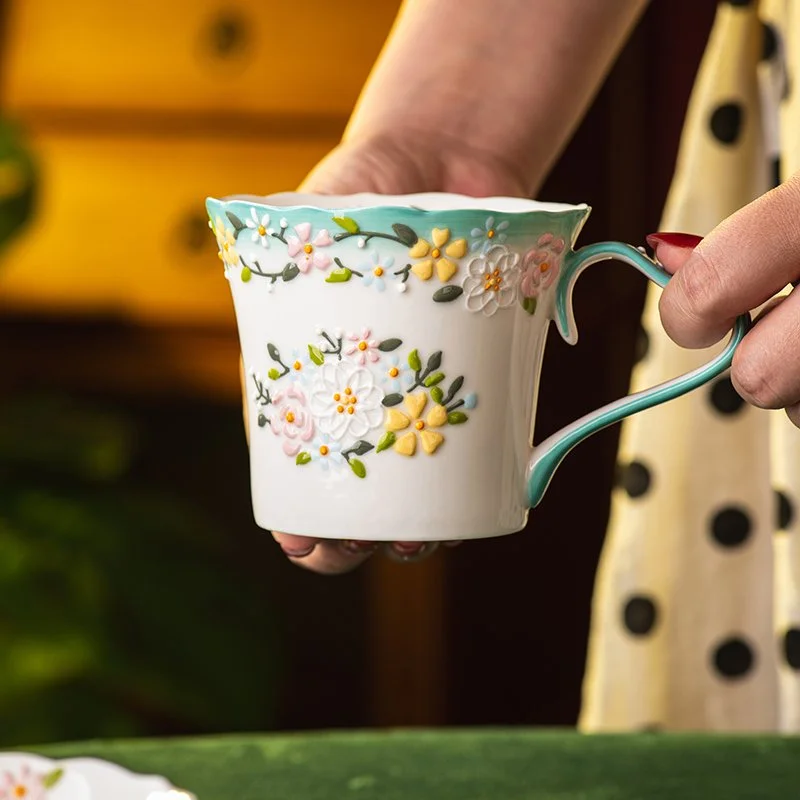
The Embossed Floral Ceramic Coffee Mug 12 oz with Handgrip (p-000593) is the slow-sipper’s mug: thick ceramic walls, a sculpted embossed pattern that adds wall thickness (which is the actual mechanism of heat retention in ceramics - more wall = slower cooling), and a handgrip that keeps your palm off the hot surface.
Why it wins the slow-sipper slot: the embossed pattern isn’t just decoration - it’s functional wall mass. This mug keeps coffee hot noticeably longer than a thin single-wall ceramic, and the 12 oz size is the right volume for a proper pour-over or a large drip coffee. The floral embossing also makes it a beautiful object, which matters when your mug lives on your desk all morning.
Honest trade-off: it’s the heaviest mug on this list - the thick walls that retain heat also make it a load to hold. If you have wrist issues or prefer a light mug, this isn’t it. And at $64.49 it’s the second-most-expensive pick; you’re paying for the handcrafted-feel embossing.
Buy it if: you sip for 30+ minutes and want heat + beauty. Skip it if: you want light and simple.
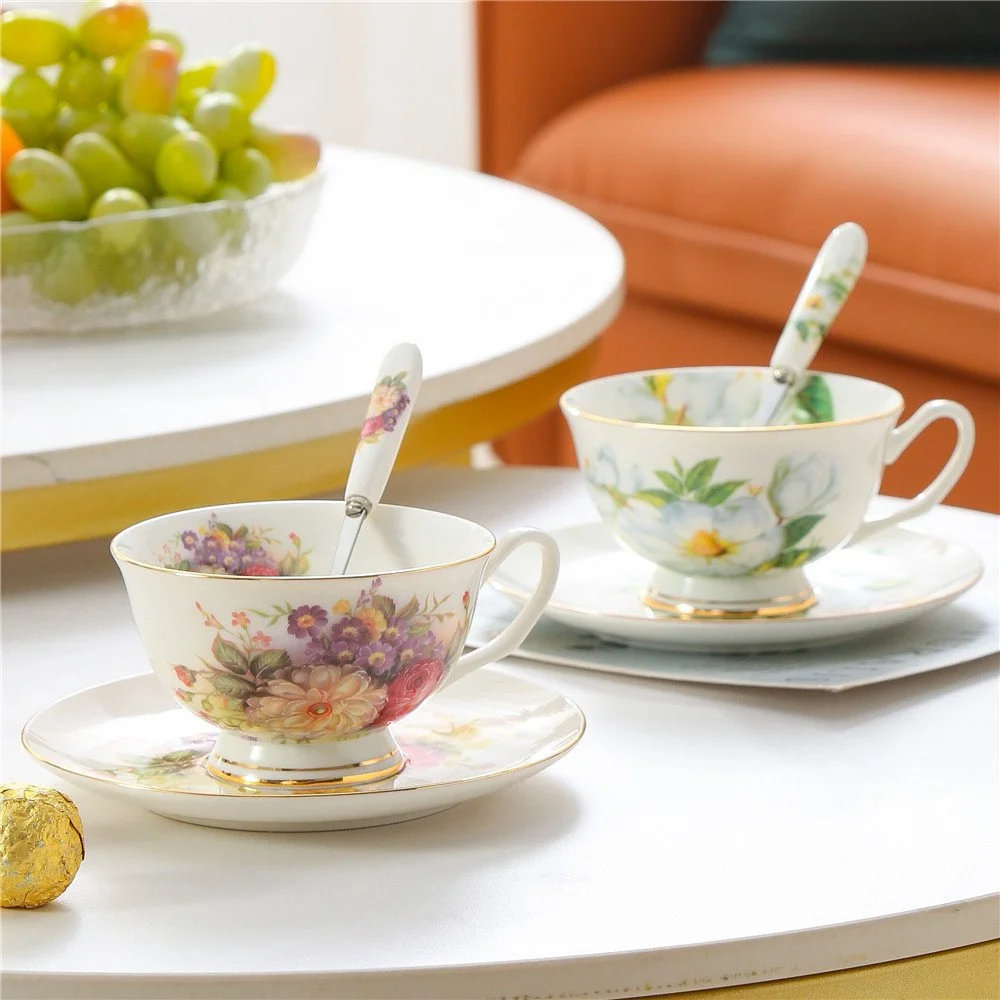
6. Best Premium Gift / Tea-and-Coffee Set: Luxury Bone China Coffee & Tea Cup Set with Saucer & Spoon - $82.65
The Luxury Bone China Coffee & Tea Cup Set with Saucer & Spoon (p-007601) is the “impress someone” pick: genuine bone china (the translucent, lightweight porcelain that’s been the gift-tier material for centuries), a saucer (for the drip-and-set-down ritual), and a matching spoon. It’s the mug-as-gift for weddings, housewarmings, and boss-appreciation.
Why it wins the premium slot: bone china is light - noticeably lighter than any ceramic mug on this list, with a delicate ring when you tap it - and it’s the material people associate with “this is a real set, not a random mug.” The saucer-and-spoon pairing makes it feel complete in a way a single mug never does.
Honest trade-off: this is the most fragile and most expensive pick. Bone china chips if you look at it wrong; it’s not for daily commuter abuse. And for pure heat retention, it’s worse than the thick ceramic and stainless picks - bone china is about elegance, not thermodynamics. Buy it as a gift or for the formal shelf, not as your daily driver.
Buy it if: gifting, formal settings, tea drinkers, collectors. Skip it if: you want one rugged daily mug.
The Decision Table
| Pick | Price | Material | Heat retention | Best for |
|---|---|---|---|---|
| Portable Stainless Camping Mug | $18.49 | Double-wall stainless | Excellent | Travel, outdoors, hard use |
| Tall Ceramic Coffee & Milk Mug | $39.65 | Single-wall ceramic (tall) | Good | Daily driver, best value |
| Cute Dog Glass Mug w/ Lid & Spoon | $48.65 | Glass | Poor | Gifts, fast drinkers, aesthetics |
| 6-Piece Stackable Steel Mug Set | $56.65 | Double-wall stainless | Excellent | Households, kids, entertaining |
| Embossed Floral Ceramic 12 oz | $64.49 | Thick ceramic | Very good | Slow sippers, desk use |
| Bone China Cup Set w/ Saucer | $82.65 | Bone china | Moderate | Premium gifts, formal |
Match the Mug to the Coffee You Actually Brew
Coffee is not one drink, and a mug that works beautifully for a small espresso can feel wrong for a large batch-brewed cup. The amount of liquid, the temperature at which you serve it, the way you add milk, and the speed at which you drink all change what matters. This is why generic lists that say one mug is “best overall” are often less useful than they sound. The best mug for a six-ounce espresso-based drink may be a poor choice for a fourteen-ounce travel pour-over.
Espresso and Short Milk Drinks
Espresso, cortado, macchiato, and small flat-white drinkers usually benefit from a smaller mug with a narrower opening. A smaller vessel keeps the drink visually full and makes it easier to control the ratio of espresso to milk. It also reduces the amount of unused air above the drink, which can make a small serving feel colder and less satisfying.
For espresso, an eight-to-ten-ounce mug is usually enough. The key features are not maximum capacity or a very tall body. Look for a stable base, a rim that feels comfortable on the lips, and a handle that leaves enough room for one or two fingers. A heavy base helps when you are placing the cup on a saucer or carrying it from the machine to a table. If you make milk drinks with a thick layer of foam, leave some headroom rather than filling the vessel to the rim.
The bone china cup set can work for a formal espresso or tea service when the visual ritual matters. A smaller ceramic cup can be more practical for daily espresso because it tolerates repeated use better. The tall ceramic pick is more suitable for a larger latte-style drink than for a short espresso, even though it can still be used for either.
Drip Coffee and Automatic Brewers
Drip coffee is where most everyday mug decisions happen. A standard home brewer may produce anything from eight to twelve ounces per serving, while many people pour a larger travel-size portion. The best daily mug is usually twelve to fourteen ounces, with enough room to add milk without making the drink feel diluted or unstable.
Single-wall ceramic is still a sensible choice for drip coffee if you drink within fifteen to twenty minutes. Ceramic does not transfer a metallic note, it is easy to clean, and it feels familiar in the hand. The tall ceramic coffee and milk mug is a strong fit for this routine because its shape gives a practical volume without requiring a huge, wide opening.
If the pot sits on a warming plate and you pour several times during the morning, a double-wall stainless mug becomes more attractive. It gives you a wider window before the coffee turns lukewarm. The trade-off is that stainless can make very hot coffee feel deceptively safe to hold, and a lid or narrow opening can make sipping too quickly easier. Let the drink cool to a comfortable temperature instead of using insulation as permission to drink immediately.
Pour-Over Coffee
Pour-over drinkers often care about aroma, clarity, and the visual experience of the coffee. A moderate-size ceramic or glass mug gives the drink enough space to release aroma while still being easy to hold. A twelve-ounce capacity works for a smaller brew, while fourteen ounces is more flexible if you add milk or brew a larger dose.
Glass is appealing because it lets you see the color and level of the coffee. That can be useful when serving guests or when you enjoy the visual part of a pour-over. It is less useful when you take forty minutes to finish the drink. Borosilicate-style glass may handle temperature changes better than ordinary glass, but it is still not an insulation system. The Cute Dog Glass Mug with Lid & Spoon is a giftable choice for fast drinkers, but it should not be treated as a slow-sipper heat-retention mug.
Thick ceramic is a better fit for a long desk session. The embossed floral twelve-ounce mug combines wall mass with a handgrip, which makes it more comfortable for a drink that stays beside a keyboard or notebook. It is heavier, so buyers should consider whether the mug will be lifted many times during the day.
French Press and Immersion Coffee
French press coffee is often served in a larger quantity, and the grounds and oils create a fuller mouthfeel. A mug with a twelve-to-fourteen-ounce capacity gives enough room for a complete serving without requiring a refill. The shape can be slightly wider than an espresso mug because aroma and ease of cleaning are more important than a narrow, concentrated presentation.
A wide opening is convenient for adding milk, stirring, and checking whether any sediment has carried over. It also cools the drink faster. If you prefer a hot French press serving over a long breakfast, choose thick ceramic or insulated stainless. If you drink with breakfast and finish quickly, ordinary ceramic remains perfectly practical.
Iced Coffee and Cold Brew
Cold drinks reverse many of the usual priorities. Heat retention is irrelevant, and a larger opening can be an advantage because it accommodates ice, milk, reusable straws, and toppings. A clear glass mug is visually attractive for layered iced coffee, but it needs enough wall strength and a stable base to handle the weight of ice.
The dog glass mug with lid and spoon can work for a small iced coffee if the lid is designed for that use and the opening is large enough for the intended straw. Do not assume that every decorative lid is leakproof. A lid that keeps dust out on a desk may not be safe in a bag. For commuting with iced coffee, use a purpose-built travel tumbler rather than treating a decorative mug as a sealed container.
Instant Coffee, Tea, and Hot Chocolate
People who alternate between coffee, tea, cocoa, and warm water usually benefit from a neutral daily mug rather than a coffee-specific shape. A twelve-ounce ceramic mug is the most flexible starting point. It gives enough room for a tea bag, milk, cocoa foam, or a spoon without making the drink feel lost in the cup.
The bone china set makes more sense when tea service is part of the experience. The saucer catches drips, the spoon completes the set, and the light body feels more refined than a heavy diner mug. For a family kitchen, the six-piece stainless set is more practical when different people want hot drinks at the same time.
The Material Decision in More Detail
Material is the first meaningful decision because it affects temperature, weight, taste, durability, cleaning, and appearance at the same time. No material wins every category. A useful guide should explain the compromise instead of treating one material as universally superior.
Ceramic: The Best Default for Most Homes
Ceramic remains the most balanced material for home coffee. It is usually neutral in taste, comfortable to hold, compatible with the visual expectations of a coffee mug, and available in almost every price range. A glazed ceramic surface is easy to wipe, and many ceramic mugs are microwave and dishwasher safe.
The important distinction is thickness and shape. A thin ceramic mug may cool quickly and transfer heat to your hand. A thick ceramic mug retains heat longer but adds weight. A tall, narrow mug can feel warmer for longer than a wide, shallow mug of the same capacity because less surface area is exposed at the top. These are practical tendencies, not guarantees. Glaze, room temperature, beverage volume, preheating, and the initial drink temperature also matter.
Ceramic is not indestructible. A mug can survive years of gentle use and chip when it hits a sink or countertop. Small chips around the rim are more than cosmetic if they create a sharp edge. Inspect older mugs and retire any that have a damaged drinking surface. Do not keep a favorite mug in service just because it has sentimental value if the rim is no longer safe or comfortable.
Double-Wall Stainless Steel: Best for Time and Travel
Double-wall stainless steel is the practical choice for people who need the coffee to remain warm while they work, commute, camp, or move around the house. The air gap between walls slows heat transfer. The same design also keeps the outside cooler than a single-wall metal cup, although the temperature and lid still affect the result.
The main objections are taste, feel, and cleaning. Some people notice a faint metallic note, especially with black coffee. Others notice no difference. Stainless also feels lighter than ceramic, which some buyers interpret as cheap even when the material is more durable. A steel interior can show coffee oils and odors if it is rinsed but not properly washed.
The portable camping mug is the right individual purchase for rough handling. The six-piece set makes sense when the household needs several durable cups. A set is less useful if everyone wants a different size or material. Before buying six, ask whether the cabinet, dishwasher, and daily routine actually benefit from one standardized cup.
Glass: Best for Visual Appeal and Fast Drinking
Glass makes a coffee look intentional. It shows color, milk layers, foam, and ice. It also avoids the metallic taste that some stainless users dislike. For a short serving or a quick drink, glass can be a very enjoyable material.
The weakness is insulation. Glass transfers heat and can make the outside hot, while the beverage loses temperature quickly. Double-wall glass improves the experience, but the current gift pick is best treated as a decorative, fast-drinking, desk-friendly option rather than an all-day thermal vessel.
Glass also needs a more careful safety routine. Avoid sudden temperature changes unless the product is explicitly designed for them. Do not pour boiling liquid into a cold, thin glass and assume it will be fine. Set the mug on a stable surface, inspect it for hairline cracks, and follow the care instructions for the lid and printed decoration.
Bone China: Best for Lightness and Gifting
Bone china is valued for its light body, translucent appearance, and formal feel. It is often associated with tea sets and special occasions because the material can look refined without the bulk of thick ceramic. A matching saucer and spoon make the purchase feel like a complete gift rather than a single object.
Its weakness is not necessarily poor quality; it is the wrong durability profile for rough daily use. A bone china set belongs in a home where it will be handled with care. It can be a beautiful choice for a wedding gift, housewarming, tea-and-coffee host, or collector. It is a poor choice for a backpack, a shared office sink, or a household where mugs are routinely dropped into a full basin.

Heat Retention: What Actually Changes the Result
People often ask which mug keeps coffee hot longest, but mug material is only one part of the equation. The starting temperature, volume, room temperature, lid, surface area, and whether the mug is preheated all change the result.
Start With the Serving Size
A small amount of coffee cools faster than a large amount because there is less thermal mass. A six-ounce drink in a ten-ounce mug may cool faster than a twelve-ounce drink in a fourteen-ounce mug, even when the mugs have the same material. This is one reason an oversized mug can disappoint. It may look generous, but a small pour spreads across a large opening and loses heat quickly.
Use a mug that leaves practical headroom instead of a large empty bowl. For a twelve-ounce brew, a fourteen-ounce mug is more useful than a twenty-ounce mug unless you regularly add ice, milk, or a large amount of foam.
Preheat When Heat Matters
Preheating is simple and often overlooked. Fill the mug with hot water, let it stand for thirty seconds, empty it, and then pour the coffee. This prevents the cold mug from absorbing the first portion of heat. The effect is more noticeable with thick ceramic because there is more material to warm.
Preheating is not necessary for everyone. If you finish coffee in ten minutes, it adds a step without a meaningful benefit. If you are a slow sipper or serve coffee to guests, it can make the experience more consistent.
Lids Help, But They Change the Drinking Experience
A lid reduces exposure to room air and helps prevent dust, splashes, and accidental spills. It does not automatically make a mug leakproof. Decorative lids may fit loosely, and a spoon slot can create a path for liquid to escape. Treat a lidded mug as a covered open vessel unless the manufacturer clearly identifies it as sealed and transport-safe.
Lids also change aroma. Coffee smell is part of the drinking experience, and a narrow opening may reduce how much aroma reaches your nose. A commuter may accept that trade for spill control. A pour-over enthusiast may prefer an open rim.
Surface Area Matters
A wide, shallow mug exposes more coffee to the air than a tall, narrow mug. That usually means faster cooling. A narrow mug can retain warmth longer, but it may be harder to clean if the opening is too small. The best shape is a compromise between thermal performance, hand comfort, spoon access, and cleaning.
Shape, Handle, Rim, and Base
Material gets most of the attention, but the shape determines whether you enjoy using the mug every day. A mug can have excellent specifications and still fail if the handle is too small, the rim is rough, or the base is unstable.
Handle Clearance
Two fingers may be enough for a small cup, but many adults prefer three fingers when carrying a full mug. Check the space between the handle and the body. A decorative handle with a tiny opening may look good but force a pinch grip. That becomes uncomfortable when the mug is heavy or hot.
People with larger hands should prioritize clearance over ornament. People with smaller hands may prefer a smaller handle that keeps the mug close to the palm. There is no universally correct handle size.
Handle Temperature
A handle can become warm even when the mug body is comfortable. This is common with thick ceramic and metal designs. Hold the empty mug first and look at how the handle attaches to the body. A thin attachment can create a hot point, while a more substantial handle distributes the load.
Rim Shape
The rim is where the mug meets the mouth, so it deserves more attention than product photography usually gives it. A thin, even rim can make coffee feel more precise. A thick rolled rim can feel familiar and sturdy but may change how the drink flows. A rough or poorly finished rim is a quality problem, regardless of price.
For people who add milk or sugar, a moderate opening makes stirring easier. For office users who sip while reading, a narrow drinking opening or lid may reduce spills. For tasting coffee, an open rim and clean interior are usually preferable.
Base Stability
A stable base matters at a busy desk or crowded kitchen counter. The mug should not rock when placed down. This is especially important for tall shapes, lightweight steel cups, and mugs with an uneven decorative bottom. A low center of gravity is helpful when children or pets share the room.
Stackability
Stackability is a storage feature, not just a space-saving trick. A stackable mug set lets you standardize the cabinet and see how much room the collection actually uses. Before buying a stackable set, check whether the handles align or create stress when stacked. Metal sets can be forgiving; ceramic handles are more likely to chip if the stack is unstable.
Six Buying Scenarios
The six products in this guide are easier to compare by routine than by rank. A product should earn its place by solving a specific problem. The following scenarios show how the picks fit real households.
Scenario One: The Morning Rusher
The morning rusher drinks coffee while checking messages, packing a bag, or getting children ready. The mug may travel from kitchen to desk to car, and spills are more important than presentation. This buyer should prioritize a stable base, a manageable volume, and a lid if the route includes movement.
The camping stainless mug is the most forgiving choice in this group. It is built around hard use and travel rather than formal serving. The user should still check the lid design, because not every camping mug is a leakproof commuter tumbler. If the mug will go in a backpack, place it upright in a separate sleeve until the seal has been tested.
The six-piece stainless set can work in a household with several morning rushers, but it may be inconvenient for a single commuter. A set creates duplicate capacity, not necessarily better mobility.
Scenario Two: The Desk Sipper
The desk sipper makes one coffee and finishes it over thirty to sixty minutes. Heat retention matters, but the mug also needs to feel pleasant while sitting next to a keyboard. A lid can reduce dust and spills, but the mug should not be so tall that it becomes easy to knock over.
The embossed floral ceramic mug is the more comfortable desk choice if the user likes a substantial ceramic body and a visible design. Its twelve-ounce capacity prevents the coffee from spreading across an oversized surface. The trade-off is weight. A desk sipper who moves the mug repeatedly between rooms may prefer stainless instead.
If the desk is shared with children, pets, or frequent meetings, durability may matter more than ceramic feel. The camping mug is the sensible compromise for a busy workspace.
Scenario Three: The Coffee Purist
The coffee purist cares about flavor neutrality, aroma, temperature, and the way the vessel feels during a deliberate brew. This person may reject stainless if they notice a metallic note and may not value a lid. Ceramic or glass is usually a better starting point.
The tall ceramic mug is the practical choice for a larger pour-over or drip serving. The dog glass mug can be enjoyable for a fast drinker who wants to see the coffee, but the printed character design and lid make it more of a lifestyle or gift object than a neutral tasting cup.
The purist should avoid choosing a mug solely because it is expensive. A high price does not guarantee a clean rim, comfortable handle, or better thermal performance. The right test is whether the mug keeps the coffee enjoyable without adding a distracting smell, taste, or handling problem.
Scenario Four: The Household of Many Drinkers
A household with several coffee drinkers needs consistent storage, enough quantity, and a material that survives the sink and dishwasher. Individual preferences may conflict. One person wants a large latte mug, another wants a small tea cup, and someone else wants a travel lid.
The six-piece stackable stainless steel set is designed for the quantity problem. It reduces breakage and gives every person a similar cup. It is especially useful for guest-heavy kitchens, family breakfasts, short-term rentals, and office break rooms. It is less satisfying when the purpose is to create a personal coffee ritual.
One practical approach is to use the set as the durable base collection and keep one or two personal ceramic mugs for slower weekend drinks. That gives the household resilience without removing individual preference.
Scenario Five: The Gift Buyer
The gift buyer needs to predict someone else’s routine. A decorative mug is easy to purchase and easy to get wrong. The recipient may already have too many novelty mugs, dislike a certain material, or drink coffee in a way the design does not support.
The dog glass mug with lid and spoon is a good gift when the recipient likes playful objects, visual coffee, and a complete accessory set. It feels more considered than a decoration-only mug because the lid and spoon have practical roles. It is not the safest gift for someone who commutes with coffee unless the recipient already uses mugs in that way.
The bone china cup set is better for a formal gift, housewarming, wedding, host gift, tea lover, or someone who enjoys a slower serving ritual. The buyer should be clear that this is a delicate set. A fragile premium gift creates a poor experience if the recipient wanted a durable daily cup.
Scenario Six: The Outdoor and Travel Drinker
The outdoor drinker values toughness, insulation, and the ability to use the mug near a tent, car, picnic table, workshop, or campsite. Stainless steel is the clear material advantage here. Ceramic and bone china add breakage risk, while glass may be difficult to protect.
The portable stainless camping mug is the direct fit for a single user. The six-piece set is useful for group camping, but the buyer should consider packing volume and whether every piece needs to travel. Stainless cups can nest or stack, but handles may still take up space.
Outdoor users should also think about cleaning access. A mug that is excellent at keeping coffee hot but difficult to rinse at a campsite can become unpleasant by the second day. A broad opening, removable lid, and simple interior are more valuable than a complex drinking mechanism in a remote setting.
How to Choose Between the Six Picks in Five Minutes
Use this sequence instead of scrolling back and forth through product cards.
- Decide whether the mug will travel outside the home. If yes, begin with the stainless camping mug.
- Decide whether you need one mug or several. If several, compare the six-piece set before individual designs.
- Decide whether the coffee should stay warm for more than thirty minutes. If yes, choose stainless or thick ceramic.
- Decide whether the mug is primarily a gift. If yes, compare the glass set for playful use with the bone china set for formal use.
- Decide whether the mug must be microwave-friendly. If yes, verify the specific product care instructions and avoid assuming that every metal mug is suitable.
- Decide how much coffee you actually pour. Do not buy a large mug for a small serving just because the listing photo makes it look generous.
- Hold the mug mentally when full. If the material, handle, or weight sounds uncomfortable, move to another category.
This process turns six products into a short decision. It also prevents a common mistake: choosing the most visually attractive mug before identifying the job.
Budget Tiers: What You Gain as the Price Rises
Price can indicate material, construction, design, or gift presentation, but it does not work as a reliable quality score by itself.
Under $20: Function First
The $18.49 camping mug is the value choice for buyers who care about durability and portability. At this level, buyers should focus on the material, lid fit, handle, and cleaning access. Decorative detail is less important than whether the mug survives the routine.
An under-$20 mug can be an excellent daily tool if it matches the habit. The buyer should not expect hand-finished decoration, a complex gift package, or the same tactile experience as thick ceramic. The correct question is whether the lower price removes a problem or creates one.
$20 to $50: The Practical Sweet Spot
This range covers the tall ceramic mug and the dog glass mug. It is where many buyers get the best balance of appearance and function. Ceramic offers a neutral daily experience; glass offers visual appeal and gift potential.
The choice inside this tier should be driven by time and handling. The ceramic mug is better for a daily home routine. The glass mug is better for someone who values the look of the drink and finishes quickly. Paying more for the glass does not buy longer heat retention.
$50 to $70: Sets and Heavier Construction
The six-piece stainless set and embossed floral ceramic mug sit in this range. The set creates value through quantity. The floral mug creates value through thicker construction and design.
Compare the total use, not only the unit price. A six-piece set at $56.65 may be less expensive per mug, but it becomes wasteful if half the pieces stay in a box. A $64.49 single mug may be worthwhile if it is the one mug used every morning for years.
$70 and Above: Presentation and Specific Craft
The bone china set at $82.65 is a presentation purchase. It earns its price through material feel, matching pieces, and the gift experience rather than superior thermal performance. This is not a criticism. A gift, host setting, or formal coffee service has different value criteria from a commuter cup.
At this level, buyers should ask what they are paying for. If the answer is a set, material, finish, or design story, the price may make sense. If the answer is only a vague “premium” label, compare the construction details before ordering.
Care, Cleaning, and Longevity
A mug lasts longer when the cleaning routine matches the material. Many failures blamed on the product are actually care problems: leaving coffee oils overnight, using abrasive tools on printed decoration, stacking chipped pieces, or exposing glass to sudden temperature changes.
Ceramic Care
Rinse ceramic after use, especially after milk drinks. Coffee oils can leave a brown film that becomes harder to remove over time. Use a soft sponge and ordinary dish soap for routine cleaning. If staining develops, use a mild cleaning method that is compatible with the glaze rather than scraping with metal.
Check the rim and handle regularly. A hairline crack may not be visible when the mug is dry, but repeated heating and cooling can make it worse. Do not microwave a damaged mug.
Stainless Care
Wash stainless thoroughly instead of only rinsing. Coffee, milk, and sweeteners can leave odors in lids and seals. If the lid has several parts, separate them during cleaning and allow them to dry completely before reassembly.
Avoid assuming that all insulated mugs are dishwasher safe. Heat, detergent, and repeated cycles can affect seals, printed finishes, and vacuum performance. Follow the product care instructions. If the product is used outdoors, rinse grit and dust away before closing the lid.
Glass Care
Protect glass from sudden temperature changes, knocks against sinks, and stacked storage where the rim can hit another object. Inspect the body and rim before each use if the mug has been dropped. Do not use a decorative glass mug as a sealed travel bottle unless the product is specifically designed for that purpose.
Printed designs often last longer with hand washing. The lid and spoon may require separate care. A soft brush can clean narrow areas without scratching the surface.
Bone China Care
Bone china should be treated as a serving set. Use a dedicated shelf, avoid unstable stacks, and do not force cups into a crowded dishwasher rack. The saucer and spoon should be stored so they do not strike the cup rim.
If the set is used daily, it can still last, but the handling standard must be consistent. Do not buy a delicate set for a person who wants to place it in a backpack every morning.
Microwave, Dishwasher, and Food-Safety Questions
Marketing language often says “easy care” without answering the question buyers actually have: can I put this mug in the microwave or dishwasher every day?
Ceramic and many glass mugs are commonly microwave-compatible, but metallic decoration, painted rims, lids, and unknown materials can change the answer. Stainless steel should generally be kept out of a microwave. A product listing should be checked for specific care instructions instead of relying on material assumptions.
Dishwasher safety is also product-specific. A ceramic mug can be dishwasher safe while its printed artwork fades. A stainless mug can be dishwasher safe while its lid seal should be washed by hand. A bone china set can tolerate careful dishwasher use but still be at higher risk of chipping in a crowded rack.
The practical rule is simple: if a feature is important to your routine, verify that feature on the product page before purchase. Do not buy a mug because it looks dishwasher-friendly. Do not assume a lid is leakproof. Do not assume a glass mug is heat-shock resistant.
Common Coffee Mug Mistakes
Buying Capacity Instead of Fit
Large mugs are visually persuasive. They suggest abundance and fewer refills. But a large mug can make a normal serving look small, cool faster across a wide surface, and become heavy when full. Capacity is useful only when it matches the beverage amount.
Choosing a Lid Without Testing the Seal
A lid can be a dust cover, splash reducer, or travel seal. Those are different jobs. A dust-cover lid may not survive an upside-down bag. A splash reducer may still leak through a straw opening. Identify the intended role before relying on it.
Paying for Decoration Instead of Construction
A decorative pattern can make a mug feel special, but the buyer should still inspect the useful details: wall thickness, rim, handle, base, material, and care instructions. The embossed floral mug earns attention because the visual detail is connected to wall mass and hand feel. That is a stronger reason than decoration alone.
Ignoring the Full Mug Weight
A mug that feels light when empty may be comfortable. A thick mug that feels reassuring may become tiring after coffee is added. Estimate the full weight, especially for older users, children, people with wrist pain, and anyone who carries the mug between rooms.
Buying a Set for a Single-Person Routine
Sets are useful when quantity solves a real problem. They are not automatically better value. A six-piece set can create clutter if the household only uses two mugs. It can also prevent each drinker from choosing a preferred size.
Leaving Milk Coffee in the Mug
Milk residue is harder to clean than black coffee residue. Rinse milk drinks soon after finishing. This matters particularly for travel lids, gaskets, and narrow interiors where residue can remain hidden.
Using a Decorative Mug as a Travel Container
A mug with a lid is not automatically a travel mug. Check whether it is designed to resist tipping, whether the lid locks, and whether the opening is safe for movement. Use a dedicated sealed tumbler when the drink will travel in a bag.
A Simple At-Home Mug Test
You can evaluate a mug in one morning without special equipment.
- Fill it with the amount of coffee you normally drink.
- Hold it with the handle for thirty seconds.
- Place it beside your normal work surface.
- Take three sips at the same pace you usually use.
- Set it down and pick it up again after fifteen minutes.
- Check whether the coffee is still enjoyable after thirty minutes.
- Wash it by hand and inspect whether the interior is easy to reach.
- Check whether the mug fits your cabinet, dishwasher, and microwave routine.
This test reveals more than an isolated claim such as “keeps coffee hot.” It measures the combined experience of temperature, grip, weight, rim, size, and cleanup. A mug can score well on heat and fail on every other part of the day.
Which Mug Is Best for Milk, Sugar, and Add-Ins?
Milk and sugar change the practical shape of a coffee routine. A person who drinks black coffee may need only the mug and a spoon. A person who adds milk, syrup, cinnamon, whipped cream, or ice needs more headroom and a more accessible opening.
The tall ceramic mug is useful for coffee and milk because the height leaves room for stirring without splashing. The dog glass mug includes a spoon, which makes it giftable for someone who sweetens drinks. A narrow travel opening can be convenient for spill control but frustrating when you need to stir or add ingredients.
If you routinely add a large amount of milk, do not choose a mug based on the black-coffee volume alone. A fourteen-ounce mug may be more practical than a ten-ounce mug even if the coffee portion starts small. Leave enough room to stir without touching the spoon against a fragile rim.
FAQ (Direct Answers to What People Actually Ask)
Q: What is the best brand for coffee mugs? A: There is no single “best brand” - the brand question is really a material question. For daily ceramic, mid-priced brands (like the tall ceramic pick here) beat designer names on value. For double-wall stainless, dedicated stainless brands win. For gifts, bone china is the traditional answer. Buy the material that matches your habit, then choose the best-priced version of that material. The $80+ designer mugs don’t hold coffee any better than a $40 thick ceramic mug.
Q: What is the best mug to drink coffee from? A: For most people, a 12-14 oz thick ceramic mug (holds heat 30-40 minutes, feels good in hand, dishwasher safe). For slow sippers who want 60+ minutes of heat, double-wall stainless. For fast drinkers, any ceramic or glass mug - heat retention doesn’t matter if the coffee’s gone in ten minutes. The “best” mug is the one that matches how long you actually take to finish a cup.
Q: Where can I buy high quality coffee mugs? A: Online marketplaces with real product listings and honest specs (like the catalog this guide draws from) give you the widest price range. Specialty kitchen retailers carry the premium tiers. The practical rule: buy from somewhere with a return policy and real photos, and check the material spec (thick ceramic, double-wall, bone china) rather than the brand name.
Q: Do expensive mugs keep coffee hot longer? A: Only if they’re made of a heat-retaining material - thick ceramic walls, double-wall construction, or stainless. An expensive thin mug keeps coffee hot no better than a cheap one. The mechanism is wall mass and insulation, not price. This is why the $39.65 thick ceramic pick beats a $70 designer mug for slow sippers.
Q: Is stainless steel bad for coffee taste? A: Some people detect a faint metallic note from stainless mugs, especially with black coffee. It’s not universal - many people notice nothing. If you’re sensitive to it, ceramic or glass avoids the issue entirely. The trade: stainless holds heat far longer. Try one before committing to a set.
Q: What’s the ideal mug size? A: Espresso / short drinks: 8-10 oz. Drip / pour-over: 12-14 oz. Iced or constant-refill drinkers: 16+ oz. Match the mug to the amount you actually pour - an oversized mug makes the same coffee look weak and cools faster.
Q: What mug keeps coffee hot the longest? A: Double-wall stainless usually keeps coffee warm longer than ordinary single-wall ceramic or glass because the air gap slows heat transfer. Thick ceramic can also perform well, especially when preheated. The exact result depends on drink volume, starting temperature, lid use, room temperature, and how often the mug is opened. Choose stainless for maximum practical heat retention, ceramic for a more neutral and familiar drinking experience.
Q: Is ceramic or stainless steel better for coffee? A: Ceramic is usually better for a neutral taste, a traditional hand feel, and microwave use. Stainless is usually better for durability, travel, and longer heat retention. There is no universal winner. Choose ceramic for a calm home routine and stainless for movement, outdoor use, or a household where breakage is a frequent problem.
Q: Is glass a good material for a coffee mug? A: Glass is a good choice when you value appearance, want to see the coffee, or finish the drink quickly. It is a weaker choice for long heat retention and rough handling. A glass mug with a lid can be useful on a desk, but do not assume that a decorative lid makes it leakproof or safe for a bag.
Q: How many ounces should a coffee mug hold? A: Eight to ten ounces suits espresso-based drinks and smaller servings. Twelve to fourteen ounces suits most drip coffee and pour-over routines. Sixteen ounces or more suits iced coffee, large milk drinks, or people who refill less often. Buy for the volume you actually drink, not the largest capacity shown in a product photo.
Q: Are bigger coffee mugs better? A: Bigger mugs are better only when you regularly use the extra capacity. An oversized mug can make a normal serving look small, increase the surface area exposed to air, and become heavy when full. For most daily coffee, twelve to fourteen ounces is a more flexible starting point than a very large mug.
Q: Is a mug with a lid worth buying? A: A lid is worth buying when it solves a real problem: dust at a desk, splashes during movement, or heat loss while you work. Check whether the lid is only a cover or is designed to seal. A decorative lid can reduce contamination without being suitable for transport. If you commute with coffee, choose a product clearly designed for leak resistance.
Q: What is the safest mug for a child or busy household? A: A durable stainless mug with a stable base is generally easier to manage than glass or bone china in a busy household. Still check the handle, lid, and temperature before serving. Insulation can make the outside feel cooler than the coffee inside, so do not rely on touch alone to decide whether a drink is safe.
Q: Does a thick mug keep coffee hot? A: Thick ceramic can slow cooling because it contains more material and can hold more thermal mass, especially when preheated. It is not the same as double-wall insulation, so stainless usually has the advantage for long retention. Thick ceramic wins when you want a warmer-feeling, neutral, substantial mug rather than maximum portability.
Q: Should I preheat my coffee mug? A: Preheating helps slow sippers and people serving guests. Fill the mug with hot water briefly, empty it, and then add coffee. It matters less if you finish a small drink quickly. Preheating is a useful habit, but it cannot turn a thin glass mug into an insulated vessel.
Q: What is the best mug for pour-over coffee? A: A twelve-to-fourteen-ounce ceramic mug is the most flexible choice for pour-over. Choose glass if you enjoy seeing the coffee and finish quickly. Choose thick ceramic if you drink slowly and want a warmer serving. The ideal shape leaves enough room for the brew without spreading a small serving across a very wide surface.
Q: What is the best mug for espresso? A: Use a smaller eight-to-ten-ounce vessel with a stable base and a comfortable rim. A large mug can make an espresso or cortado feel visually lost and may cool the drink faster. For formal service, a cup with a saucer can be more appropriate than a large daily mug.
Q: What is the best mug for iced coffee? A: Choose a larger glass or purpose-built insulated tumbler with enough room for ice, milk, and a straw. Glass is attractive for layered drinks but fragile. If the drink will travel in a bag, choose a sealed travel product rather than a decorative mug with a loose lid.
Q: Do stainless steel mugs change coffee flavor? A: Some drinkers notice a faint metallic note, while others do not. The effect can depend on the person, the coffee, the mug’s interior finish, and cleaning. If taste neutrality is your priority, choose ceramic or glass. If durability and heat retention matter more, stainless may still be the better overall tool.
Q: Can I put a stainless steel coffee mug in the microwave? A: Generally, no. Metal and microwaves are not a safe combination unless a product is explicitly designed and labeled for that use, which is uncommon. Use ceramic or compatible glass for microwave reheating, and follow the specific product instructions.
Q: Why does my coffee mug smell even after washing? A: Coffee oils, milk residue, lid seals, and narrow crevices can retain odors. Rinse soon after use, separate removable lid parts, wash with appropriate dish soap, and let everything dry fully. Stainless lids and silicone seals often need more attention than a plain ceramic interior.
Q: Are expensive coffee mugs worth it? A: They can be worth it for a specific material, design, gift presentation, or personal ritual. They are not automatically better at keeping coffee hot. Compare the construction and daily fit before paying for a premium label. A reasonably priced mug that suits your routine is a better purchase than an expensive mug that stays in a cabinet.
Q: Where should I store coffee mugs? A: Store daily mugs where they are easy to reach without moving other items. Keep fragile glass and bone china away from crowded shelves and heavy cookware. Stackable stainless mugs are useful when cabinet space is limited. The best storage location is the one that makes the mug easy to use and easy to return after washing.
Q: How often should I replace a coffee mug? A: Replace a mug when it has a sharp chip, crack, unstable handle, damaged seal, persistent odor, or finish that is flaking into the drinking area. Age alone is not a reason to replace a safe mug. Inspect the rim and handle more often than the body because those are the areas most likely to affect safe use.